

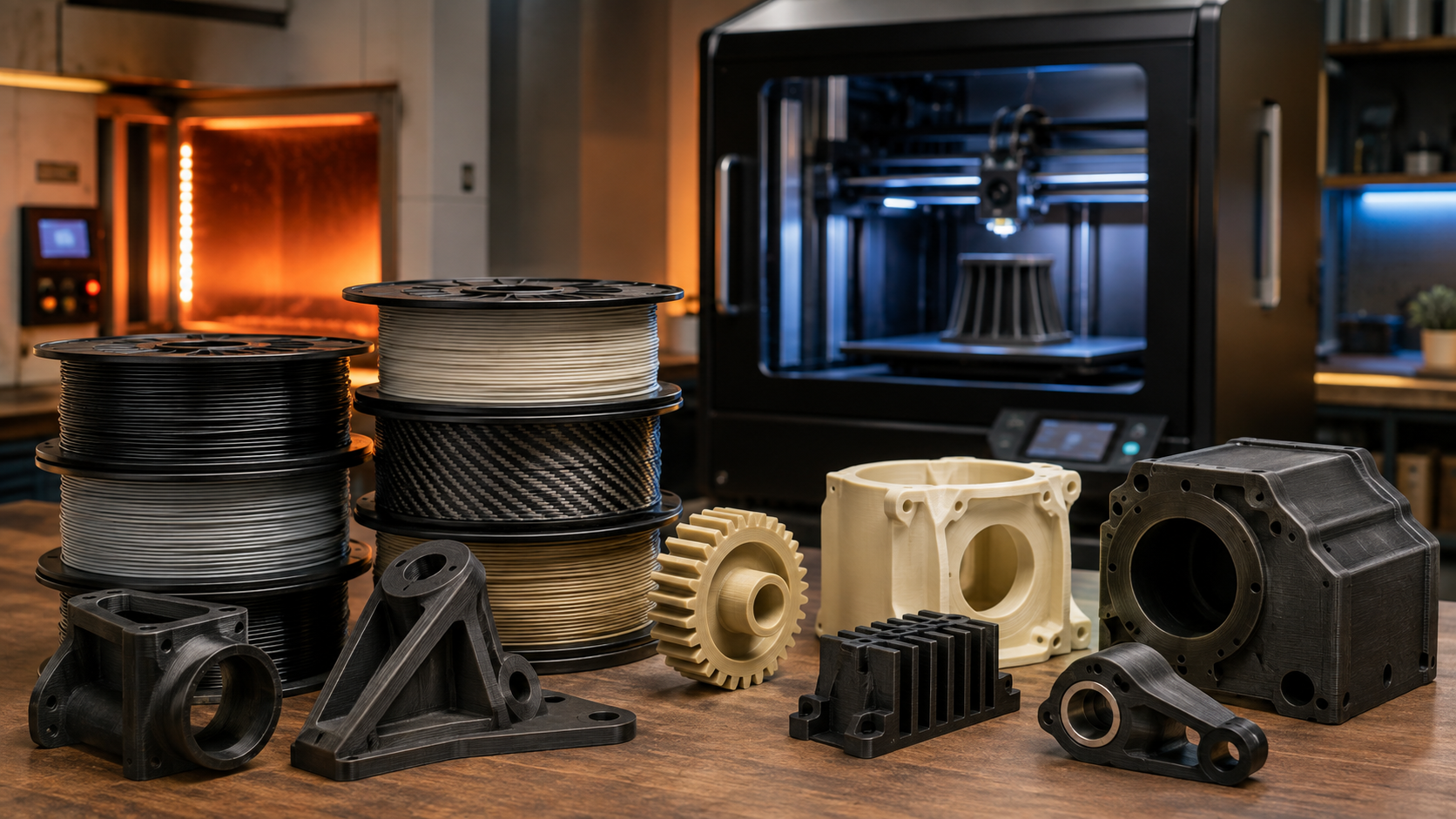
Choosing a 3D printing material for a part exposed to heat requires more than simply selecting the strongest filament available.
A material can be mechanically strong at room temperature and still soften, creep or lose dimensional accuracy when exposed to elevated temperatures.
This is particularly important for functional parts used around:
Different FDM materials respond to heat in very different ways.
PLA may be perfectly suitable for a rigid indoor component but can begin to soften at temperatures that materials such as ABS, ASA, nylon or polycarbonate can tolerate much more effectively.
Engineering-grade reinforced filaments can provide even greater dimensional stability, but they also require more demanding printing conditions.
In this guide, we compare some of the most common heat-resistant 3D printing materials and explain how PLA, PETG, ABS, ASA, nylon, polycarbonate and carbon-fibre reinforced filaments behave when temperature becomes an important part of the design.
If you are comparing materials for functional components generally, you may also want to read our Strongest Materials for 3D Printing guide.
For more specialised engineering materials, see our Nylon 3D Printing – Strength and Durability and (Carbon Fibre Reinforced Filament Guide).
If you already have a part ready for production, you can use our 3D printing service UK or upload your STL or STEP file through our instant quote / upload page.
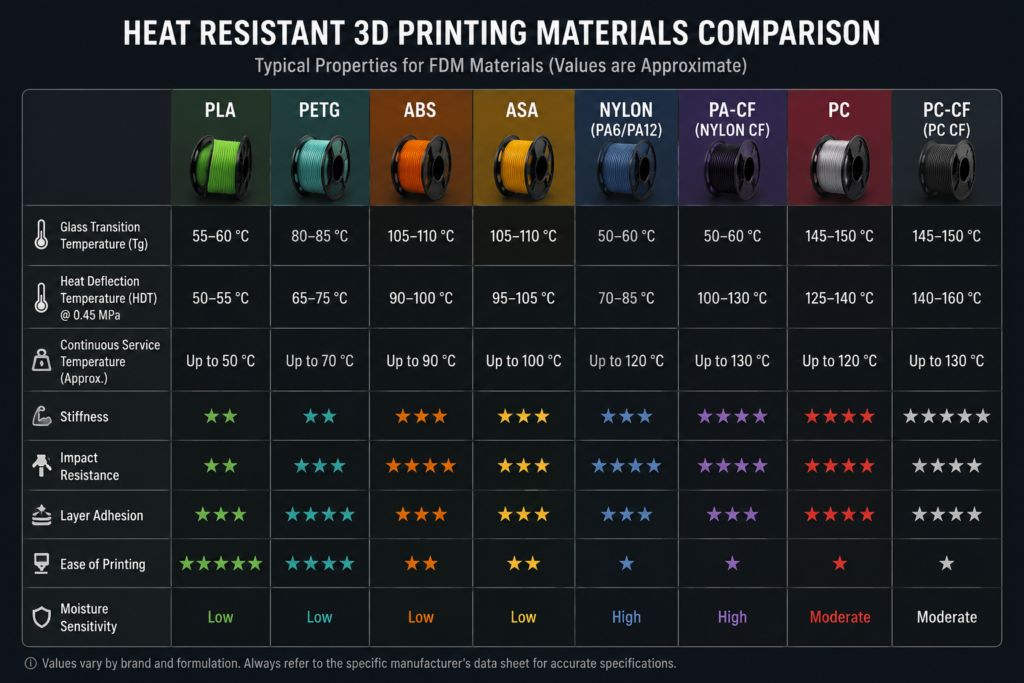
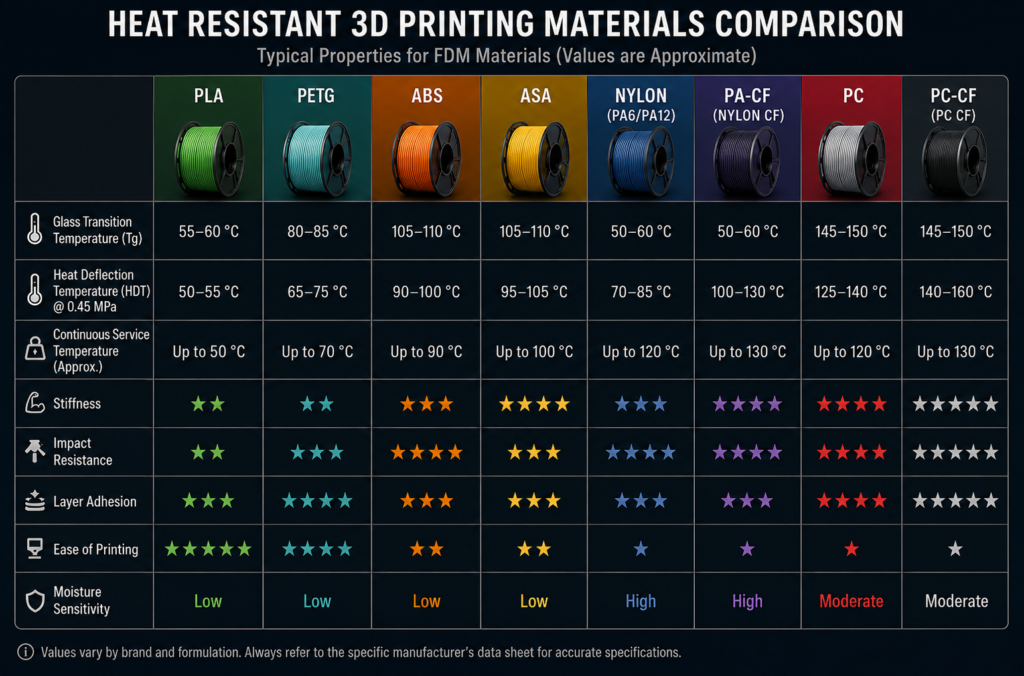
Heat resistance is often treated as a single number, but several different material properties can describe how a polymer behaves at elevated temperatures.
Important specifications can include:
These values are not interchangeable.
A material does not need to melt before a printed part becomes unusable.
A bracket may begin to flex.
A mounting hole may deform.
A clip may lose its clamping force.
A component under continuous load may slowly change shape.
For functional 3D printing, the important question is therefore not simply:
“At what temperature does this filament melt?”
The more useful question is:
“At what temperature will this printed component stop performing its intended function?”
That depends on both the material and the design.
The glass transition temperature, often abbreviated as Tg, describes a temperature range where an amorphous polymer changes from a relatively rigid state to a softer and more flexible state.
This does not mean that the material suddenly melts.
Instead, its mechanical behaviour changes.
For example, a rigid PLA component exposed to enough heat may begin to soften and deform long before the polymer reaches its melting temperature.
This is one reason why glass transition behaviour matters so much in functional 3D printing.
Heat deflection temperature, or HDT, describes how a material behaves under a specified load while being heated.
This can be particularly useful for engineering parts because many real components are not simply sitting in a warm environment.
They are carrying a load at the same time.
A material may appear stable when heated without load but deform considerably when a force is applied.
For brackets, fixtures, mounts and mechanical components, this distinction can be critical.
Another important factor is exposure time.
A part that experiences 100°C for a few seconds may behave very differently from a part held at 80°C for several hours.
Long-term heat exposure can cause:
This is why material selection should consider both the maximum temperature and how long the component will remain exposed to it.
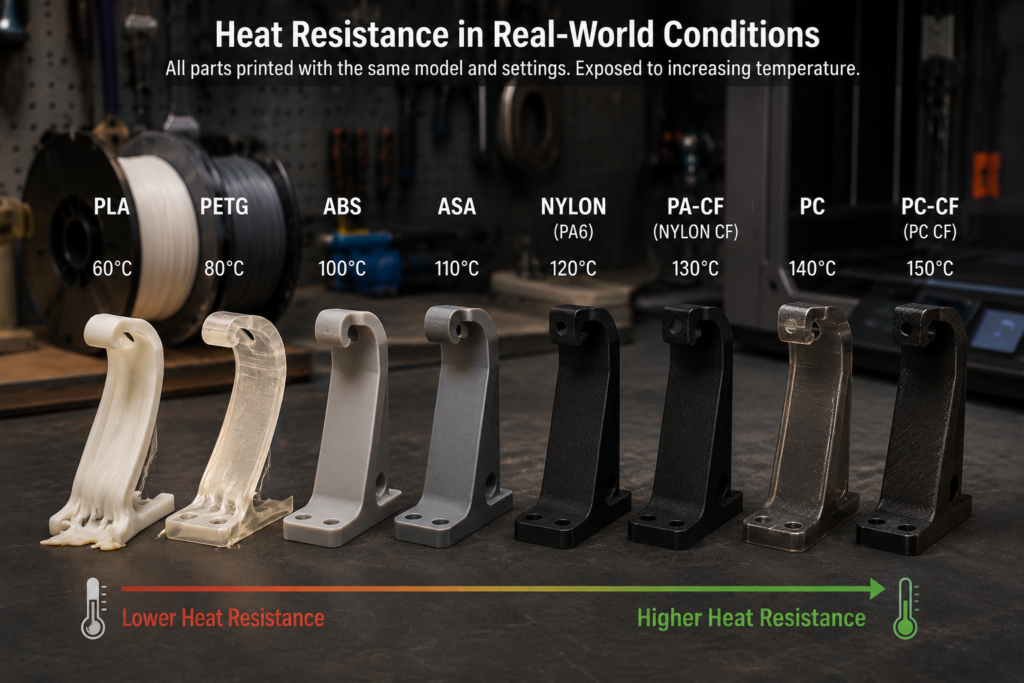
Temperature affects more than the polymer itself.
The geometry and printing process also influence how a component behaves.
Important factors include:
A thick, well-designed component may remain functional at a temperature where a thin version of the same material deforms.
The strongest heat-resistant filament cannot rescue poor geometry.
Material and design must work together.
PLA is stiff, easy to print and dimensionally accurate.
At normal indoor temperatures, it can perform extremely well.
However, standard PLA has relatively limited heat resistance.
In many formulations, significant softening can begin around the temperature range found inside:
This makes PLA unsuitable for many applications where elevated temperature is expected.
PLA is therefore a strong material in some respects, but heat is one of its main limitations.
You may also want to read PLA vs PETG vs ABS – Which Material Is Best for a broader comparison of common FDM materials.
PLA can sometimes be annealed after printing.
Annealing involves heating the finished component under controlled conditions so that the polymer structure becomes more crystalline.
Depending on the PLA formulation, this can improve temperature resistance.
However, annealing can also cause:
This makes annealed PLA less attractive for precision components unless the process is carefully controlled.
For some applications it can be useful, but it should not automatically be treated as a direct replacement for ABS, ASA, nylon or polycarbonate.
PETG offers better temperature performance than standard PLA.
It also provides:
PETG can therefore be a very practical choice for functional parts exposed to moderate heat.
Typical applications include:
However, PETG is still not usually considered a true high-temperature engineering material.
When temperatures increase further, ABS, ASA, nylon or polycarbonate may provide better performance.
PETG also tends to be more flexible than PLA, which can become more noticeable as temperature rises.
ABS has long been used for functional plastic components because it combines:
This makes ABS suitable for many components used around moderately elevated temperatures.
Common applications include:
ABS can remain mechanically useful in environments where PLA would already become too soft.
However, ABS is more difficult to print reliably.
It tends to shrink as it cools, which can cause:
A controlled printing environment and enclosed machine are often beneficial.
A future guide on (When to Use ABS for 3D Printing) will examine ABS in more detail.
ASA shares many characteristics with ABS but provides an important additional advantage:
better resistance to UV and weather exposure.
This makes ASA particularly useful when a component must handle both heat and outdoor conditions.
ASA can be suitable for:
For applications involving direct sunlight, rain and changing temperatures, ASA can often be a better choice than standard ABS.
It still requires controlled printing conditions because shrinkage and warping can occur.
A future (Best Materials for Outdoor 3D Prints) guide will compare ASA, PETG and other outdoor materials in more detail.
Nylon can provide excellent mechanical performance at elevated temperatures, but there is no single temperature rating that applies to all nylon filaments.
Different polyamides behave differently.
Common nylon families include:
Some nylon formulations provide significantly better temperature performance than materials such as PLA and PETG.
Nylon also offers:
This makes it valuable for functional parts exposed to both heat and mechanical loading.
Typical applications include:
However, nylon absorbs moisture from the air.
Moisture can affect:
Proper drying and storage are therefore essential.
Our Nylon 3D Printing – Strength and Durability guide explains these requirements in detail.
Carbon-fibre reinforced nylon can provide even greater stiffness and dimensional stability than standard nylon.
The short carbon fibres reduce flexing and can help the material maintain its geometry under load.
PA-CF is commonly used for:
Heat performance still depends primarily on the nylon base polymer.
Carbon fibre does not magically convert a low-temperature polymer into a high-temperature one.
However, reinforcement can help reduce deformation and improve stiffness at elevated temperatures.
This can make PA-CF particularly valuable for rigid functional components.
Our (Carbon Fibre Reinforced Filament Guide) explains reinforced materials in greater detail.
Polycarbonate is one of the most capable engineering materials commonly available for FDM 3D printing.
It can provide:
Polycarbonate is often considered for parts used in significantly warmer environments than PLA or PETG can tolerate.
Typical applications include:
However, polycarbonate is also considerably more demanding to print.
Depending on the grade, successful printing may require:
This means PC should be selected because the application requires its performance, not simply because it occupies a more impressive position on a material specification sheet.
PC-CF combines a polycarbonate base with short carbon fibres.
This can increase:
PC-CF can be particularly useful for rigid parts exposed to both mechanical load and elevated temperature.
Potential applications include:
However, it remains a demanding material.
Printer capability and process control become increasingly important as engineering polymers become more specialised.
Beyond common FDM materials, there are specialist polymers designed for much more demanding temperatures.
Examples include:
These materials can provide exceptional thermal, chemical and mechanical performance.
They are used in specialised industries such as:
However, these polymers require specialised high-temperature printers.
Requirements can include:
For most ordinary functional parts, these materials are unnecessary.
ABS, ASA, nylon, PC or reinforced engineering filaments can often provide sufficient performance at much lower manufacturing complexity and cost.
Not necessarily.
Carbon fibre primarily reinforces the mechanical structure of the polymer.
It can increase stiffness and reduce deformation.
However, the base polymer still determines much of the thermal behaviour.
For example:
A carbon-fibre filled PLA should therefore not be assumed to provide the same heat resistance as PC-CF simply because both materials contain carbon fibres.
The letters before “CF” matter.
Heat becomes particularly important when a part is carrying a load.
A component may appear completely stable when placed in a warm environment without any force applied.
Under load, however, the same material may gradually deform.
This effect is commonly described as creep.
Creep can cause:
Material selection for high-temperature parts should therefore consider both temperature and mechanical stress.
FDM parts are anisotropic.
This means their mechanical performance can vary depending on direction.
At elevated temperatures, poor layer orientation can become even more important.
Consider:
A well-oriented ABS component may perform better than a poorly oriented engineering-polymer part.
Expensive filament remains tragically incapable of correcting bad engineering.
Thin sections heat more quickly and can deform more easily.
Wall thickness therefore influences thermal performance.
Functional parts exposed to heat may benefit from:
However, simply making everything extremely thick is not always the answer.
The component should be designed so that material is concentrated where mechanical loads actually occur.
Increasing infill can improve stiffness, but infill should not be treated as the only structural setting.
Part performance also depends on:
For many functional components, additional walls can provide a more useful increase in strength and thermal stability than simply increasing infill towards 100%.
A future (How Infill Affects 3D Printing Strength) guide will explore this topic in more detail.
Automotive environments are a common reason for selecting more heat-resistant materials.
Vehicle interiors can become surprisingly hot in direct sunlight.
Components near:
may experience even higher temperatures.
PLA is often unsuitable for these applications.
Depending on the location, suitable materials may include:
The correct choice depends on actual temperature, UV exposure, load and required dimensional stability.
Electronics generate heat.
An enclosure may need to tolerate:
For low-power electronics, PETG may be sufficient.
For warmer environments, ABS, ASA, nylon or PC may be more appropriate.
The design can also improve thermal behaviour through:
Material choice is important, but thermal design matters too.
Motors generate both heat and vibration.
This creates a difficult combination for some plastics.
A suitable material may need:
Depending on the temperature and load, nylon or reinforced nylon can be excellent options.
For applications requiring greater rigidity, PA-CF or PC-CF may be worth considering.
Outdoor temperature is not limited to the temperature shown by a weather forecast.
Dark plastic parts exposed to direct sunlight can become significantly hotter than the surrounding air.
Outdoor components must also tolerate:
ASA is particularly useful because it combines useful heat resistance with strong weather and UV performance.
PETG can also be practical for many outdoor applications.
The exact environment should always be considered.
Before selecting a material, determine the real operating conditions.
Do not design only around normal room temperature.
Consider worst-case conditions.
Continuous exposure is often more demanding than short temperature spikes.
This can significantly increase the risk of deformation.
A material with higher stiffness at temperature may be required.
Heat resistance alone is not enough if the polymer becomes too brittle.
UV and weather resistance become additional requirements.
Thermal expansion and creep may affect assemblies and precision fits.
Some engineering polymers require much higher temperatures and controlled chambers.
The best material is therefore not simply the one with the highest temperature rating.
It is the one that balances thermal, mechanical and environmental requirements for the actual part.
For general guidance:
Best for:
Main limitation:
Low heat resistance
Best for:
Main advantage:
Good balance of toughness, printability and moderate heat resistance
Best for:
Main advantage:
Good heat resistance combined with toughness
Best for:
Main advantage:
Heat resistance combined with strong weather resistance
Best for:
Main advantage:
Excellent toughness, fatigue resistance and useful thermal performance
Best for:
Main advantage:
High stiffness and dimensional stability
Best for:
Main advantage:
Excellent combination of heat resistance and mechanical strength
Best for:
Main advantage:
High stiffness combined with strong thermal performance
Sometimes the problem is not the material.
Excessive temperature may be reduced through better design.
Possible improvements include:
A redesigned PETG component may sometimes perform better than an unnecessarily expensive engineering-polymer component placed directly beside a heat source.
Material should be one part of the solution, not the entire solution.
Material selection becomes particularly important when a part is:
At 3DRevolution, we can review your model and help determine whether PETG, ABS, ASA, nylon, carbon-fibre reinforced materials, polycarbonate or another option is appropriate for the application.
You can upload your STL or STEP file through our instant quote / upload page or learn more about our 3D printing service UK.
Heat resistance is one of the most important considerations when choosing a material for functional 3D printing.
PLA provides excellent stiffness and easy printing but is limited in warm environments.
PETG offers a practical improvement for moderate temperatures, while ABS and ASA provide stronger performance in warmer applications.
Nylon combines useful heat resistance with excellent toughness and fatigue performance, making it suitable for demanding mechanical components.
Polycarbonate and reinforced engineering materials such as PA-CF and PC-CF provide additional performance where stiffness, dimensional stability and elevated temperatures are important.
However, there is no universal best heat-resistant filament.
The correct material depends on:
The strongest high-temperature part is therefore created by combining the right polymer with suitable geometry, correct print orientation and realistic understanding of the environment in which the component will operate.