

Choosing the right material is one of the most important decisions in FDM 3D printing. A model may be designed perfectly, but the finished part can still crack, soften, warp, or fail if the material does not suit its intended use.
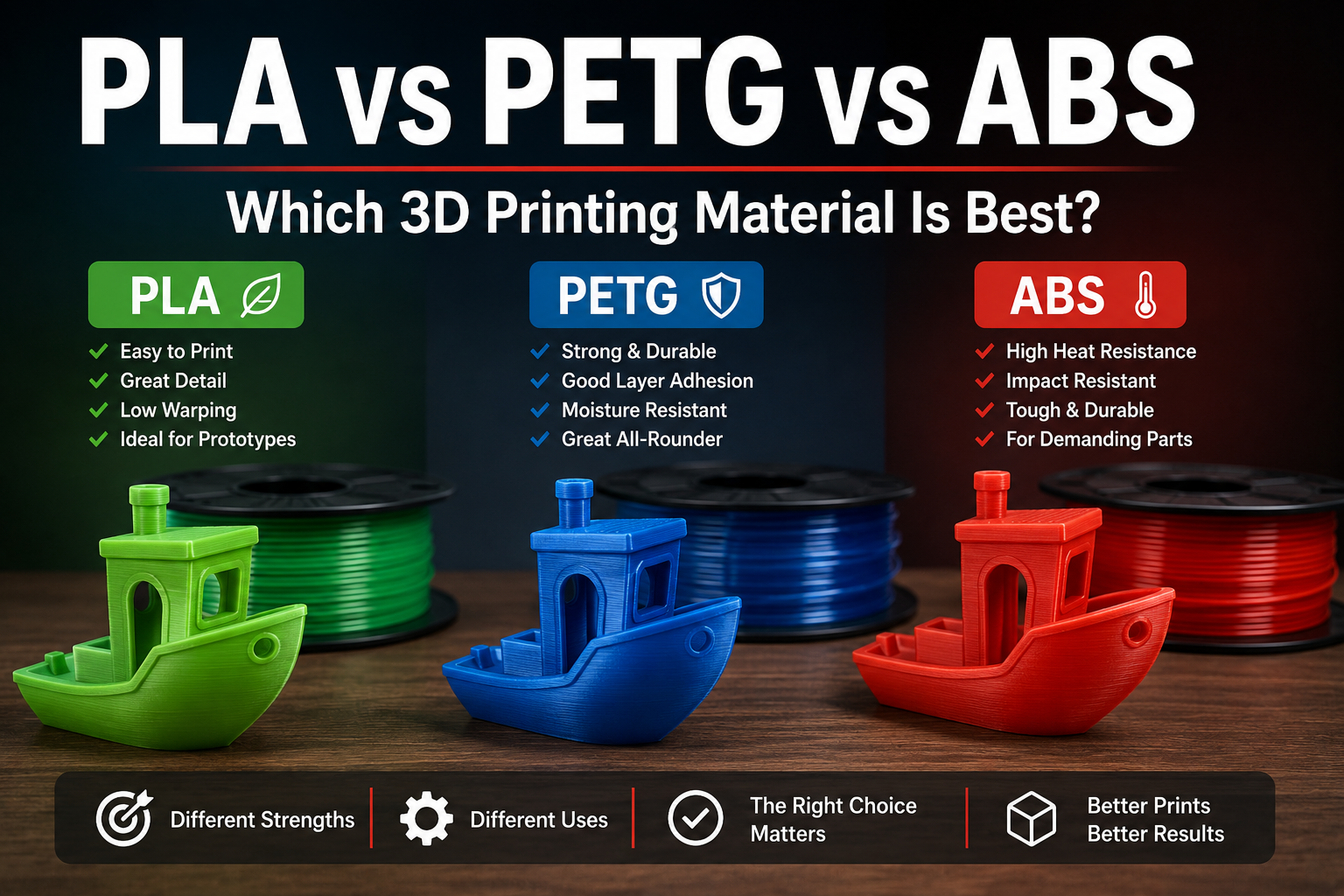
PLA, PETG, and ABS are three of the most widely used 3D printing materials. Each has different strengths, weaknesses, printing requirements, and practical applications. PLA is easy to print and produces clean detail, PETG offers a useful balance of strength and durability, while ABS provides better heat and impact resistance but requires more controlled printing conditions.
In this guide, we compare PLA vs PETG vs ABS to help you choose the best material for prototypes, mechanical parts, enclosures, replacement components, decorative models, and general 3D printing projects.
If you already have a model ready for production, you can use our 3D printing service UK or upload your file through our instant quote / upload page.
There is no single material that is best for every 3D printing project.
As a general rule:
For many everyday functional parts, PETG is often the best all-round option. PLA remains the easiest material to print, while ABS is usually selected when heat resistance and toughness matter more than printing convenience.
PLA stands for polylactic acid. It is one of the most popular materials used in desktop FDM 3D printing because it is easy to print, widely available, and capable of producing clean surface detail.
PLA normally prints with limited warping and does not always require a fully enclosed printer. This makes it suitable for prototypes, decorative models, visual samples, and general parts that will be used indoors.
PLA offers several practical benefits:
PLA is also quite stiff, which can be useful for parts that need to maintain their shape under light loads.
PLA also has important limitations:
PLA parts can feel strong during normal handling, but stiffness should not be confused with toughness. PLA may resist bending well, yet still snap when subjected to impact or repeated stress.
PETG stands for polyethylene terephthalate glycol-modified. It combines some of the easier printing characteristics of PLA with improved durability, layer adhesion, moisture resistance, and impact resistance.
PETG is commonly used for functional parts, protective covers, brackets, enclosures, workshop components, and replacement parts.
PETG is popular because it offers:
PETG can flex slightly before breaking, making it more forgiving than PLA for parts exposed to vibration, knocks, or repeated handling.
PETG is not perfect, because apparently materials also enjoy making life unnecessarily complicated.
Common disadvantages include:
PETG requires more careful tuning than PLA, particularly for retraction, cooling, temperature, and first-layer adhesion.
ABS stands for acrylonitrile butadiene styrene. It is a durable engineering thermoplastic commonly used for functional parts, automotive components, housings, tools, and products that need improved heat and impact resistance.
ABS can produce strong and durable parts, but it is more difficult to print successfully than PLA or PETG.
ABS offers:
ABS is often selected when a part may experience heat, impact, vibration, or regular mechanical use.
The main disadvantages are related to printing difficulty:
ABS is therefore better suited to controlled machines and experienced printing workflows rather than open-frame desktop printers placed beside somebody’s houseplant and optimism.
Strength is more complicated than simply asking which material is strongest.
A material may be:
These properties are not the same.
PLA is generally stiff and can perform well under steady loads. However, it is relatively brittle and may crack under impact or repeated flexing.
PLA is suitable for:
PETG is less brittle and usually has stronger layer bonding than PLA. It can absorb more impact and flex slightly before failing.
PETG is suitable for:
ABS offers a useful combination of toughness, impact resistance, and heat resistance. Properly printed ABS can be a strong choice for demanding functional parts.
ABS is suitable for:
Actual strength depends heavily on the filament grade, print orientation, wall thickness, layer adhesion, infill, and printing conditions.
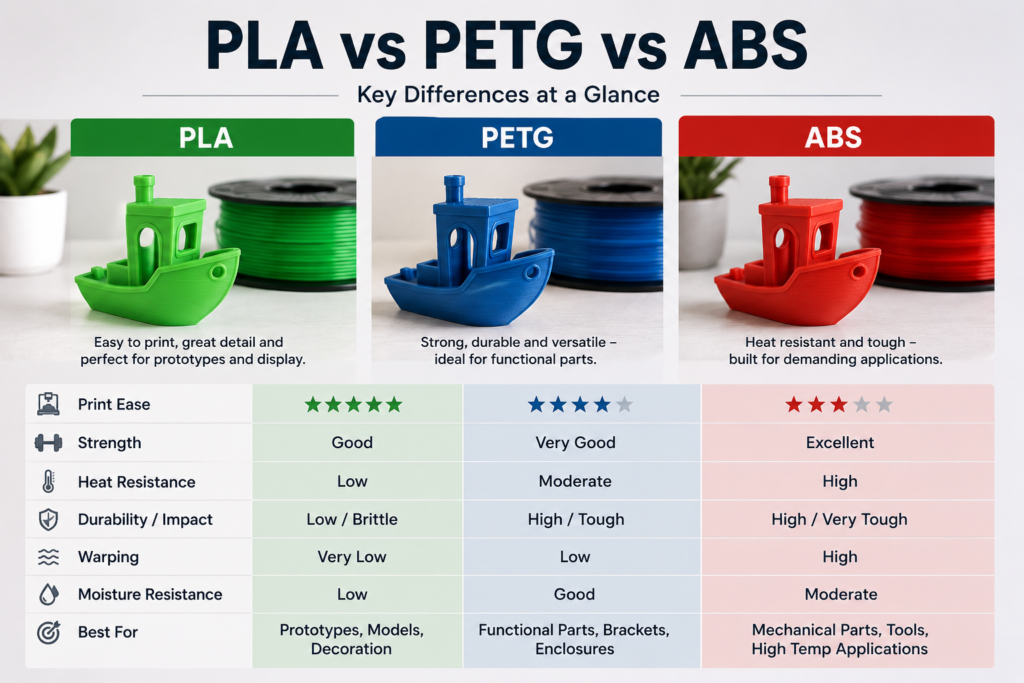
Of these three standard materials, ABS generally offers the best heat resistance.
The typical order is:
PLA may soften or deform in warm environments, including inside vehicles during hot weather. PETG handles moderate heat better, while ABS is more suitable for components exposed to elevated temperatures.
However, no generic material name guarantees a precise service temperature. Different brands and modified formulations behave differently, so the manufacturer’s technical data should be checked for critical applications.
Among PLA, PETG, and ABS, PETG is often the most practical general choice for parts exposed to moisture or occasional outdoor conditions.
PETG offers:
PLA can become brittle or deform over time in harsh conditions. ABS handles heat well but standard ABS may gradually degrade under prolonged ultraviolet exposure.
For long-term outdoor use with strong sunlight, ASA is often preferred over standard ABS because of its improved UV resistance. But among the three materials compared here, PETG is usually the easiest outdoor option for general non-critical parts.
PLA usually provides the cleanest and most predictable surface finish with standard printing settings.
PLA is well suited to:
PETG can produce attractive prints, but it may show:
ABS can produce good surfaces when printed in a controlled enclosure. It is also suitable for sanding, filling, painting, and vapour smoothing.
For visual parts straight from the printer, PLA is usually easiest. For parts that will be heavily post-processed, ABS offers more finishing options.
The general order from easiest to most demanding is:
PLA normally requires the least adjustment and has a low risk of warping. It is the easiest starting point for most models.
PETG requires more attention to:
ABS benefits from:
Large ABS parts are especially vulnerable to lifting corners and layer separation.
For general functional parts, PETG is often the best starting point.
It provides:
PLA may still be suitable for rigid functional components used indoors without heat or impact. ABS becomes the better choice when the part must withstand higher temperatures or more demanding mechanical use.
Before ordering, it is also important to confirm that the model itself is suitable for production. Our guide How to Check If a Model Is 3D Printable explains how geometry, dimensions, wall thickness, and orientation affect the finished part.
PLA is usually the best choice for early prototypes because it:
For functional prototypes that will be tested under impact, vibration, or regular handling, PETG may be more appropriate.
ABS is usually reserved for prototypes that specifically need to represent heat-resistant or impact-resistant final components.
For brackets and light mechanical parts:
The final choice should consider:
Material alone cannot compensate for a poorly designed part. A badly oriented ABS bracket may perform worse than a correctly designed PETG component.
PLA can work well for low-temperature electronic housings and visual prototypes. However, heat generated by components must be considered.
PETG is often a better general option because it offers improved durability and temperature resistance while remaining relatively easy to print.
ABS may be selected for enclosures exposed to higher temperatures, mechanical stress, or demanding use.
Ventilation openings, wall thickness, screw posts, clips, and tolerances should also be designed specifically for the chosen material.
PLA normally provides the easiest dimensional accuracy because it has low shrinkage and warping.
PETG can also produce accurate parts, although stringing and flexible surfaces may affect small features.
ABS shrinks more during cooling and therefore requires careful compensation, especially on:
For functional components, a test print may be needed before producing the final batch.
You may also want to read How to Scale STL Files Correctly before changing the dimensions of an existing model.
Yes. Material selection can affect cost through:
PLA is normally the most straightforward and economical material to print. PETG may require more careful settings, while ABS can involve longer preparation and a higher risk of failed prints.
The final quote also depends on model size, print time, wall settings, infill, and quantity. Our guide How Much Does 3D Printing Cost in the UK? explains the main factors affecting 3D printing prices.
PLA may look strong but can soften in warm environments. It should not be selected for a heated location simply because it printed cleanly.
ABS offers useful performance, but its printing requirements are more demanding. PETG may provide sufficient durability with less warping risk.
PETG is generally tougher and less brittle, but PLA can be stiffer. The correct choice depends on how the part will be loaded.
A strong material can still fail along layer lines if the model is oriented badly.
Always consider:
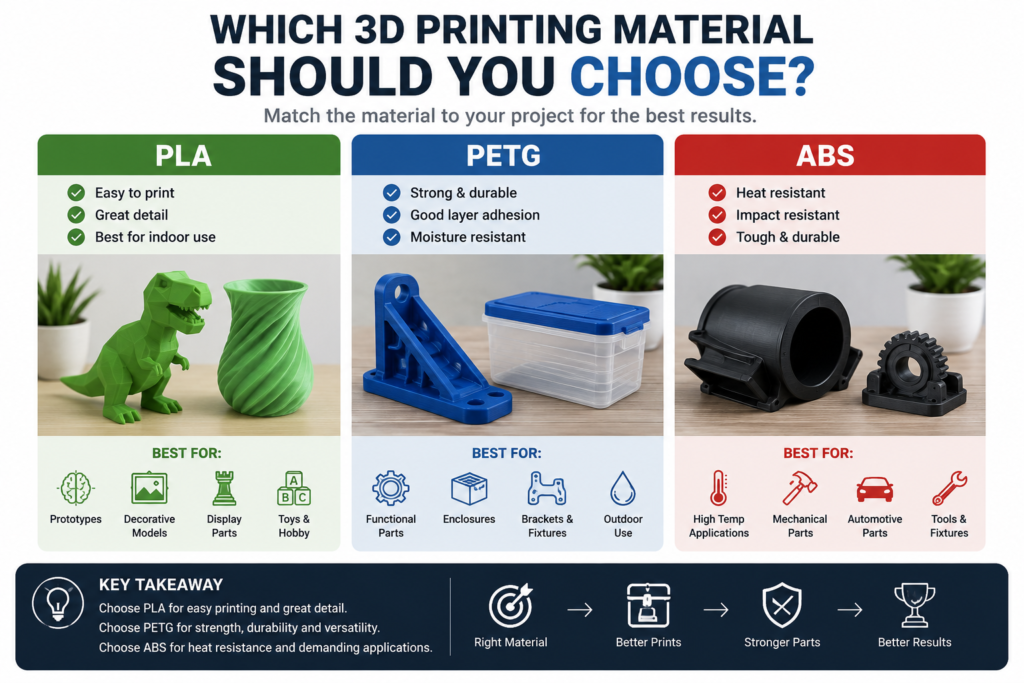
Choose PLA when:
Choose PETG when:
Choose ABS when:
Material selection becomes more important when the part is:
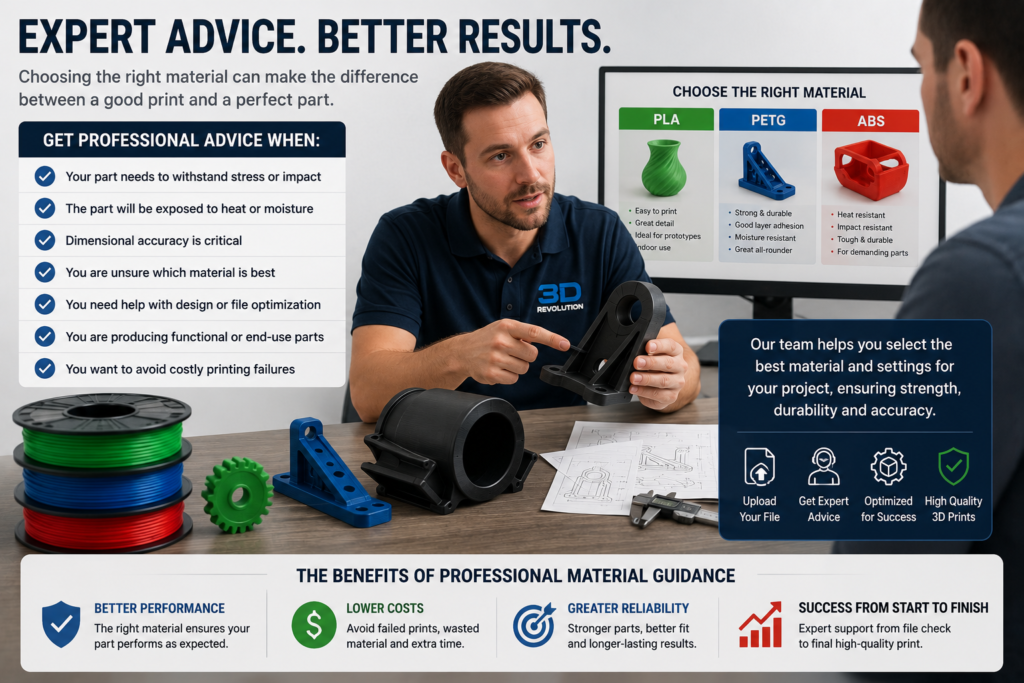
At 3DRevolution, we help customers choose suitable materials, review files, and produce custom 3D printed parts in the UK. You can upload your model through our instant quote / upload page or learn more about our 3D printing service UK.
PLA, PETG, and ABS each have a clear place in FDM 3D printing.
PLA is the easiest to print and produces excellent detail. PETG offers a strong balance of toughness, moisture resistance, and printing reliability. ABS provides better heat and impact resistance but requires a more controlled printing environment.
The best material depends on how the part will be used, not simply which plastic appears strongest on paper. Consider temperature, load, impact, moisture, appearance, tolerances, and printing conditions before making the final choice.