

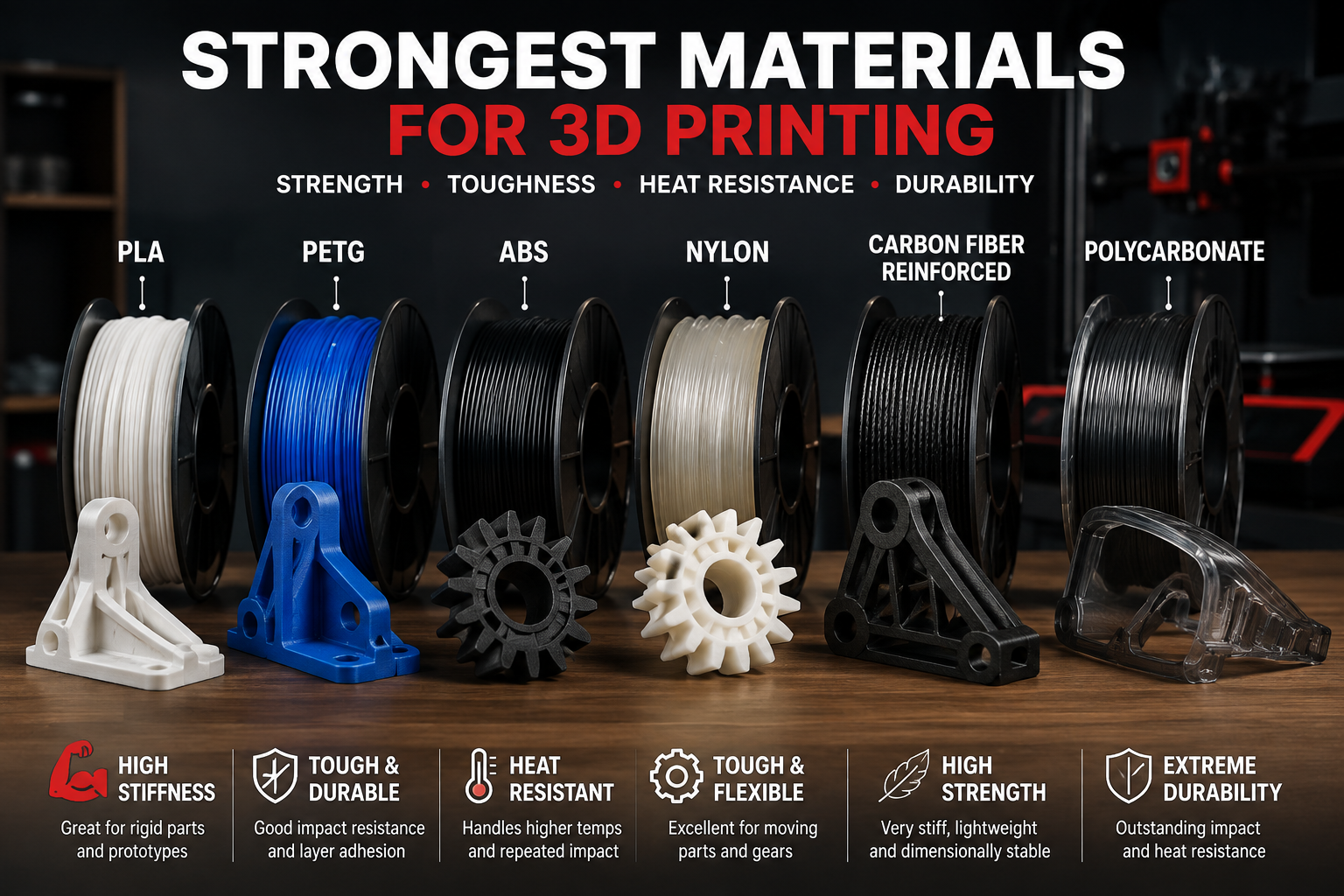
When a 3D printed part needs to withstand real mechanical loads, choosing the right material becomes just as important as the design itself.
But asking which 3D printing material is the strongest does not have one simple answer. Some materials are extremely stiff but brittle, while others can absorb impact, flex under load, or withstand higher temperatures without deforming.
In this guide, we compare some of the strongest materials commonly used in FDM 3D printing and explain when PLA, PETG, ABS, nylon, carbon-fibre reinforced filaments, and other engineering materials make sense.
If you already have a part ready for production, you can use our 3D printing service UK or upload your model directly through our instant quote / upload page.
Strength can describe several different material properties.
A material may have excellent tensile strength but poor impact resistance. Another material may flex significantly before breaking but be less rigid.
Important properties include:
This means the strongest material for a rigid bracket may not be the strongest choice for a component exposed to vibration or repeated impact.
Material selection should therefore be based on how the finished part will actually be used.
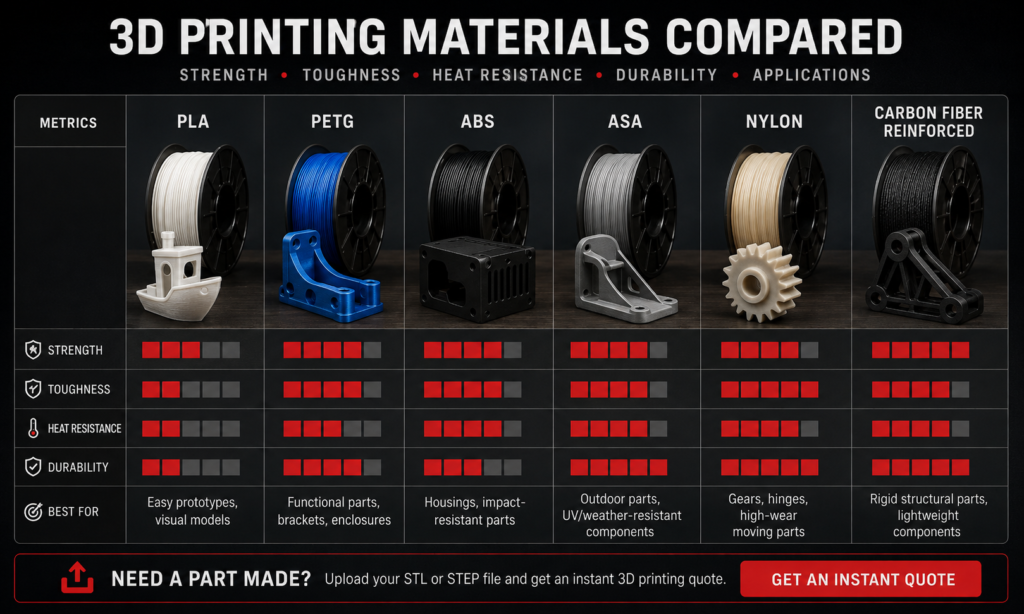
For common FDM materials, a general practical comparison looks like this:
Best for:
Main strength:
High stiffness and good tensile strength
Main weakness:
Relatively brittle and poor heat resistance
Best for:
Main strength:
Good toughness and excellent layer adhesion
Main weakness:
Less rigid than PLA and not ideal for high-temperature applications
Best for:
Main strength:
Good toughness, impact resistance, and heat resistance
Main weakness:
More difficult to print reliably
Best for:
Main strength:
Excellent toughness and fatigue resistance
Main weakness:
Absorbs moisture and requires careful printing conditions
Best for:
Main strength:
Very high stiffness with relatively low weight
Main weakness:
More brittle than some unfilled materials and abrasive to printer components
PLA is often underestimated because it is considered an easy beginner material.
In reality, PLA can be surprisingly strong when the load is applied in the right direction.
PLA provides:
For rigid indoor components, PLA may perform extremely well.
However, PLA is relatively brittle. A part may withstand a significant steady load and then suddenly crack when dropped or hit.
PLA also has limited heat resistance, making it unsuitable for components exposed to high temperatures.
You may also want to read (PLA vs PETG vs ABS – Which Material Is Best).
The answer depends on what type of strength matters.
PLA is generally stiffer, while PETG is usually tougher.
PETG can flex more before breaking and often provides very good layer adhesion. This makes it useful for parts exposed to:
For many practical functional parts, PETG offers a better balance of properties than PLA.
Typical PETG applications include:
For general-purpose functional 3D printing, PETG is often one of the safest starting points.
ABS is widely used for functional and engineering parts because it combines toughness with improved temperature resistance.
Compared with PLA, ABS is:
Properly printed ABS can perform very well in:
The main challenge is printing it correctly.
ABS tends to shrink as it cools, which can cause:
For consistent results, ABS normally benefits from an enclosed printer and controlled chamber temperature.
Nylon is one of the most useful materials when toughness and repeated mechanical movement matter.
Unlike very stiff materials, nylon can flex and absorb energy before breaking.
It offers:
This makes nylon suitable for:
However, nylon is highly hygroscopic, meaning it absorbs moisture from the surrounding air.
Wet nylon can cause poor surface quality, bubbles, weak extrusion, and inconsistent printing. Proper drying and storage are therefore important.
A dedicated guide (Nylon 3D Printing – Strength and Durability) will cover this material in greater detail.
Carbon-fibre reinforced filaments contain short carbon fibres mixed into a base polymer such as:
The fibres significantly increase stiffness and reduce deformation.
Carbon-fibre reinforced materials can offer:
They are commonly used for:
However, carbon fibre does not automatically make a filament tougher.
A carbon-filled material may be extremely stiff but more brittle than the unfilled polymer.
Carbon-fibre filaments are also abrasive and normally require a hardened nozzle and suitable extrusion components.
You may also want to read (Carbon Fiber Reinforced Filament Guide) once that guide is available.
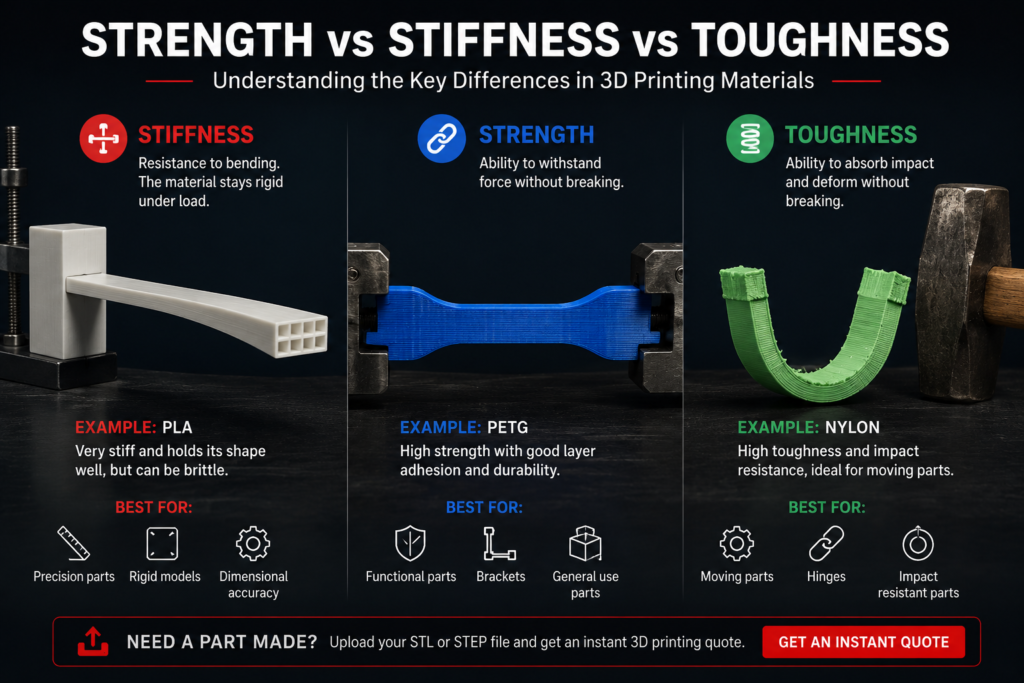
Strength and stiffness are often confused.
A stiff material resists bending.
A tough material can absorb energy before breaking.
For example:
This difference is important when designing functional parts.
A machine bracket may benefit from stiffness, while a snap-fit clip may need flexibility instead.
Choosing the wrong property can result in a part that appears strong but fails quickly in real use.
Even the strongest filament can produce a weak part if the model is printed in the wrong orientation.
FDM parts are built layer by layer.
Strength is normally greatest along the printed layers and weaker between them.
This means a load pulling directly across layer lines can cause separation.
When preparing functional parts, consider:
Sometimes rotating the model before printing can improve strength more than changing to a more expensive material.
You may also want to read How to Check If a Model Is 3D Printable.
Material is only one part of the equation.
Wall thickness can have a major effect on mechanical performance.
Increasing the number of walls can often improve strength more efficiently than simply increasing infill.
Functional components may benefit from:
Very thin walls can fail even when printed from high-performance materials.
A well-designed PETG part can therefore outperform a poorly designed carbon-fibre component.
A cruel result for anyone who hoped buying expensive filament would replace engineering.
Higher infill can increase strength, but more infill does not automatically mean a dramatically stronger part.
Strength is also influenced by:
For many functional parts, increasing wall thickness provides more useful strength than simply printing the entire model almost solid.
A future guide (How Infill Affects 3D Printing Strength) will explain this in more detail.
There is no universal winner.
For general mechanical components:
PETG
is a practical choice where durability and easy printing matter.
ABS
is useful where heat resistance and impact resistance are important.
Nylon
is excellent for moving parts, gears, hinges, and repeated mechanical loads.
Carbon-fibre reinforced nylon
can be an excellent option for stiff, lightweight engineering components.
The correct material depends on the actual environment and loading conditions.
For brackets, consider:
PLA can work extremely well for rigid, low-temperature brackets.
PETG provides more toughness.
ABS performs better around heat.
Carbon-fibre reinforced materials offer excellent stiffness for more demanding structural components.
For impact resistance, brittle materials are usually less suitable.
Materials with good toughness include:
These materials can absorb more energy before breaking.
PLA may perform well under static loading but is generally less suitable where repeated impacts are expected.
Heat changes the material ranking considerably.
Standard PLA has relatively limited temperature resistance.
PETG handles moderate heat better.
ABS provides significantly improved performance in warmer environments.
Engineering materials such as polycarbonate or specialist high-temperature polymers may be required for more demanding conditions.
For critical applications, always check the technical data for the exact filament being used.
A future article (Heat Resistant 3D Printing Materials) will explore these options in more detail.
Outdoor parts must withstand more than mechanical loads.
Important factors include:
PETG can be a practical general-purpose outdoor material.
Standard ABS handles heat well but may degrade under long-term UV exposure.
ASA is often preferred for outdoor applications because it combines useful mechanical properties with improved weather and UV resistance.
You may also want to read (Best Materials for Outdoor 3D Prints) once that guide is published.
Changing filament does not always fix a weak part.
Failure may actually be caused by:
Before switching to an expensive engineering filament, it is often worth improving the design first.
You may also want to read How to Optimize STL Files for Faster Printing and Why STL Files Fail in 3D Printing.
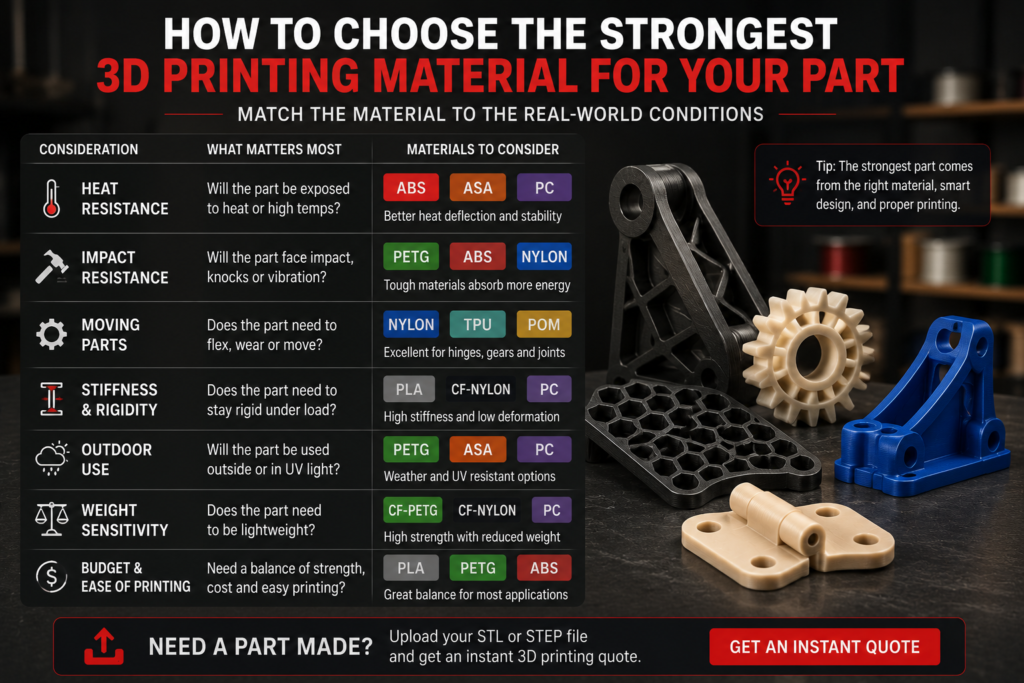
Before selecting a material, ask:
Consider PETG, ABS, or nylon.
PLA or carbon-fibre reinforced materials may be suitable.
Nylon can be an excellent option.
ABS or a suitable engineering polymer may be required.
PETG or a weather-resistant material such as ASA may be more appropriate.
Material shrinkage and printing conditions must also be considered.
There is rarely one strongest material for every application.
The best material is the one whose properties match the job.
Material selection becomes especially important when a part is:
At 3DRevolution, we can review your model and help choose a suitable material and printing approach for your application.
You can upload your STL or STEP file through our instant quote / upload page or learn more about our 3D printing service UK.
There is no single strongest 3D printing material.
PLA offers excellent stiffness, PETG provides useful toughness and layer adhesion, ABS combines durability with improved heat resistance, while nylon and carbon-fibre reinforced materials offer additional performance for demanding engineering applications.
The strongest finished part comes from combining the right material with good design, correct orientation, suitable wall thickness, and proper printing conditions.
Choosing material based on the actual application rather than simply chasing the highest strength number produces more reliable and useful 3D printed parts.