

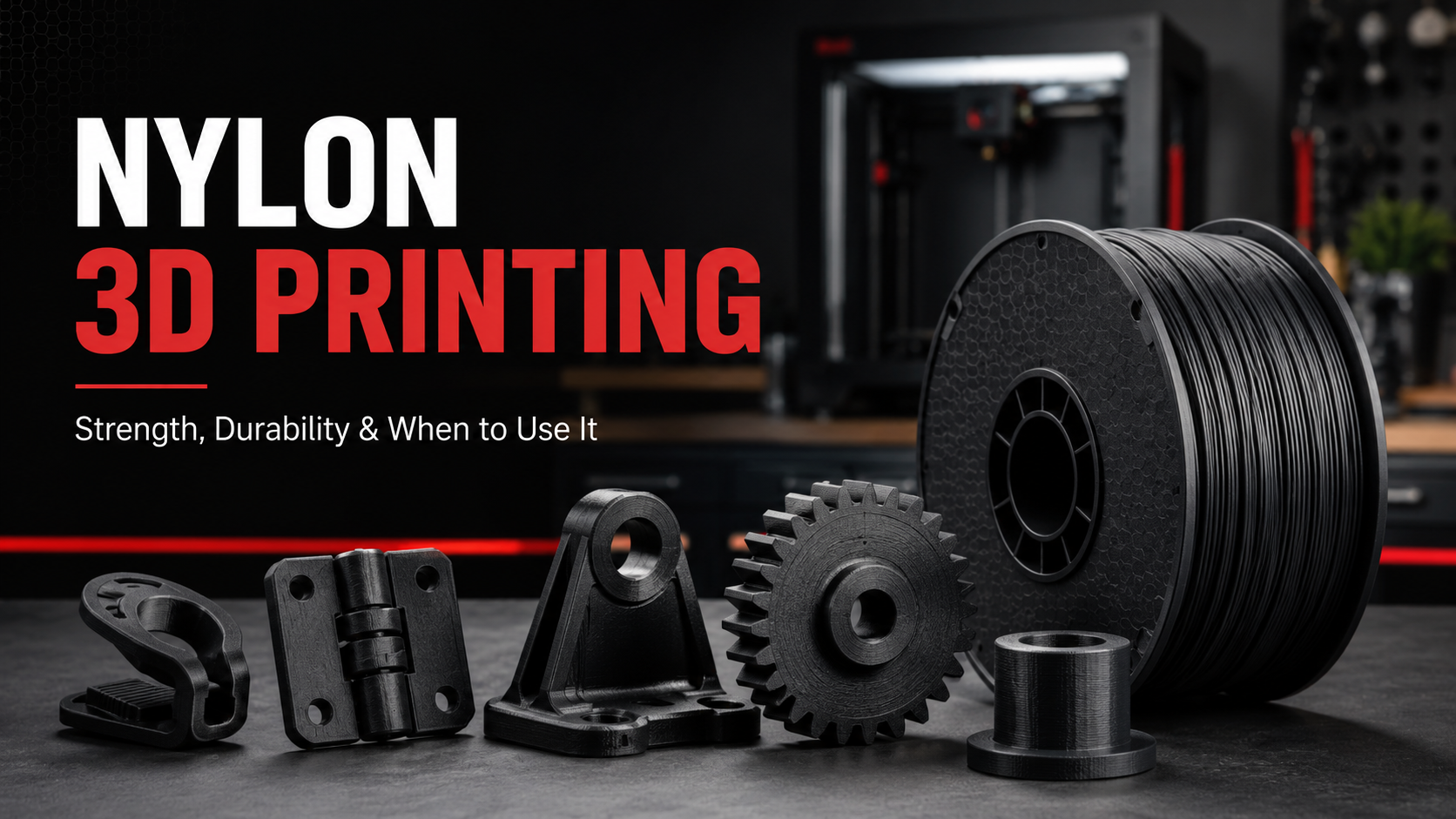
Nylon is one of the most capable materials available for functional FDM 3D printing.
It combines strength, toughness, impact resistance, fatigue resistance and useful flexibility in a way that many common filaments cannot match. This makes nylon particularly valuable for mechanical parts that need to survive repeated movement, vibration, wear or accidental impact.
However, nylon is also more demanding to print than materials such as PLA or PETG.
It absorbs moisture from the air, can warp during printing and often requires careful temperature control, proper filament drying and suitable printer hardware.
For this reason, nylon is best treated as an engineering material rather than simply another general-purpose filament.
In this guide, we explain how strong nylon 3D prints really are, where nylon performs better than PLA, PETG or ABS, which types of nylon are commonly used, and when it makes sense to choose nylon for a functional part.
If you are comparing several engineering materials, you may also want to read our Strongest Materials for 3D Printing guide.
If you already have a functional part ready for production, you can use our 3D printing service UK or upload your model through our instant quote / upload page.
Nylon belongs to a family of engineering thermoplastics known as polyamides.
Unlike PLA, which is commonly chosen for ease of printing, appearance and rigidity, nylon is usually selected because of its mechanical behaviour.
Depending on the exact grade, nylon can provide:
These properties make nylon useful for components that need to do more than simply hold their shape.
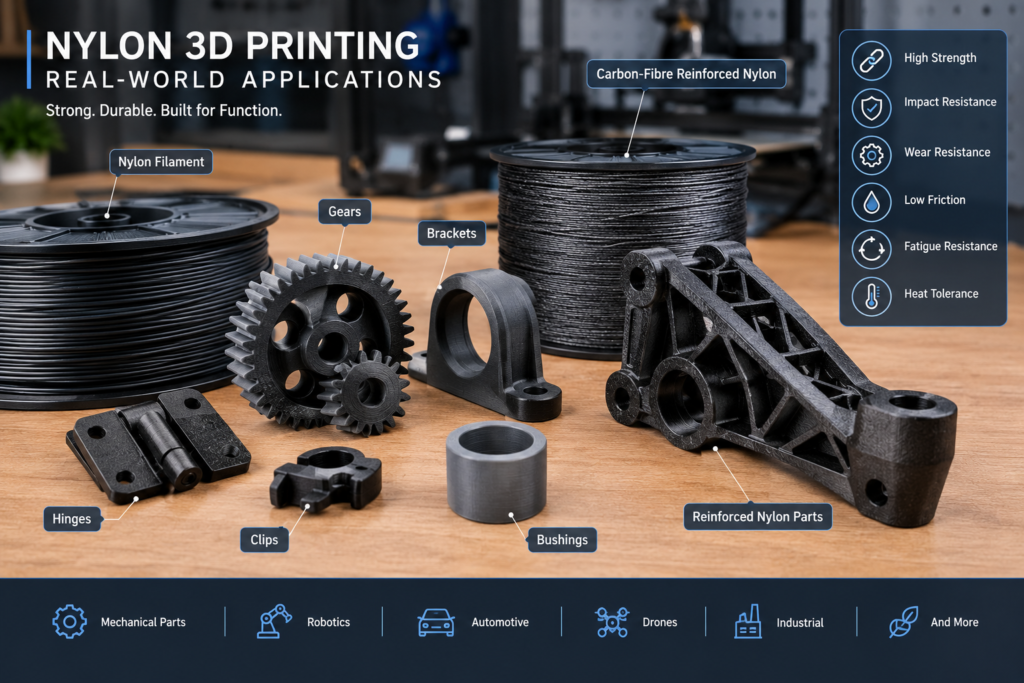
Typical applications include:
Not every nylon filament behaves in exactly the same way.
Different polyamide formulations can vary significantly in stiffness, moisture absorption, heat resistance, flexibility and printability.
Nylon can produce extremely strong functional parts, but its main advantage is not simply having a high number on a tensile-strength specification sheet.
Its real strength comes from the combination of several mechanical properties.
A nylon part can often absorb deformation and impact without suddenly cracking.
This makes it very different from a material such as PLA.
PLA can be extremely stiff and can perform very well under a steady load, but it is relatively brittle. Under impact or repeated bending, it may fail suddenly.
Nylon is generally more tolerant of movement.
A properly designed nylon component may flex under load and then return towards its original shape rather than immediately breaking.
This behaviour makes nylon especially useful where the part experiences:
For engineering components, that can be more valuable than maximum stiffness.
This distinction is important.
A stiff material resists bending.
A strong material can carry significant load before failing.
A tough material can absorb energy and deformation before breaking.
Nylon is generally much tougher than PLA, but it is often less rigid.
That means a nylon bracket may flex more than the same bracket printed in PLA.
That does not necessarily mean the nylon part is weaker.
In an application where some movement is acceptable, the nylon part may survive conditions that cause the more rigid PLA part to crack.
This is why material selection should always be based on the actual job rather than a single strength number.
Our Strongest Materials for 3D Printing guide explains this distinction in more detail.
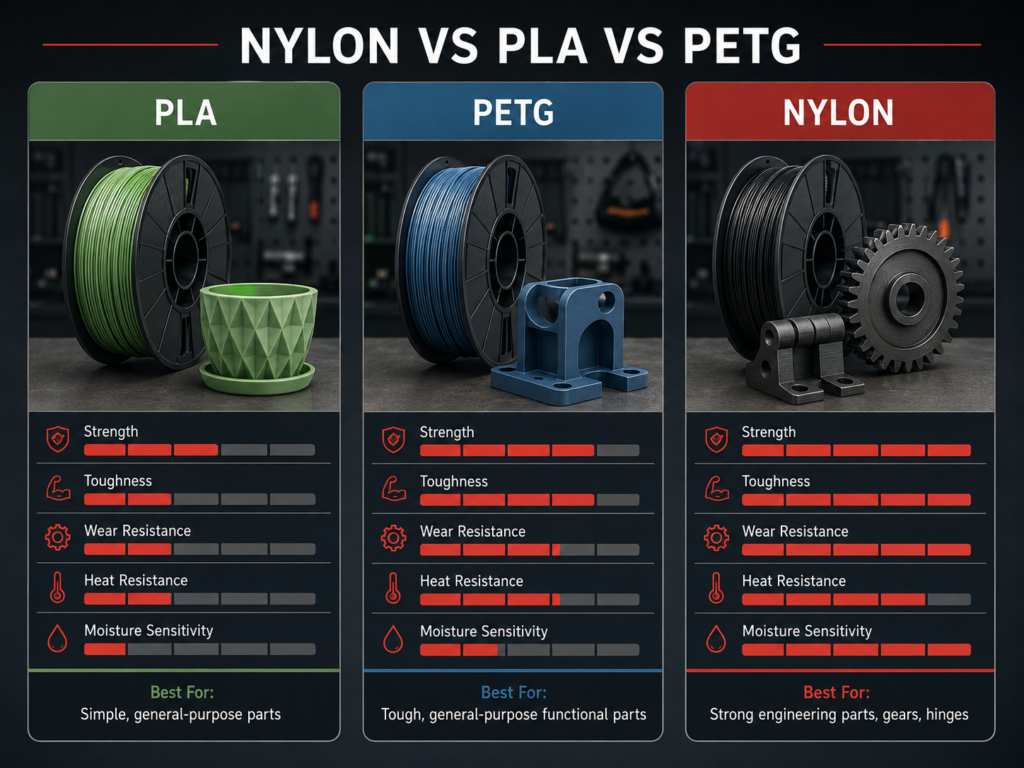
PLA is one of the easiest materials to print and provides excellent stiffness and dimensional accuracy.
Nylon behaves very differently.
For a rigid display fixture or indoor bracket, PLA may be completely suitable.
For a hinge, gear, clip or moving mechanical part, nylon may be the better choice.
Material performance depends heavily on part design, print orientation and the exact filament grade, so neither material should be treated as universally stronger.
PETG is often used as a practical middle ground between easy-printing materials and more demanding engineering filaments.
It offers good layer adhesion, useful toughness and resistance to moisture.
Nylon can provide better performance in demanding mechanical applications, particularly where fatigue, movement and wear are involved.
For a general enclosure or workshop bracket, PETG may be the more practical choice.
For gears, hinges, clips or components experiencing repeated mechanical movement, nylon can offer significant advantages.
You may also want to read PLA vs PETG vs ABS – Which Material Is Best for a broader comparison of common FDM materials.
ABS is another commonly used functional material.
It provides good toughness, impact resistance and temperature performance while remaining relatively rigid compared with many nylon grades.
Nylon generally offers better fatigue resistance and can tolerate repeated flexing more effectively.
ABS may be preferred for:
Nylon may be preferred for:
Neither material is universally better.
The correct choice depends on whether rigidity, movement, impact, wear or temperature resistance is more important.
Impact resistance is one of nylon’s major strengths.
A brittle material can carry a considerable static load but still fail when dropped, struck or suddenly loaded.
Nylon behaves differently.
Its ability to deform can help absorb some of the energy from an impact rather than concentrating all of the stress into one brittle failure point.
This can make nylon useful for:
This does not mean every nylon print is automatically impact resistant.
Poor layer bonding, incorrect printing temperatures, wet filament or badly oriented layers can still create weak parts.
Material properties cannot rescue poor manufacturing.
Fatigue resistance describes how well a material survives repeated loading cycles.
This is different from simply surviving one large load.
A part may be bent thousands of times, repeatedly vibrated or continually loaded and unloaded.
Eventually, some materials develop cracks and fail.
Nylon is often selected for applications involving repeated movement because it can perform well under cyclic loading.
Examples include:
This is one reason nylon is widely considered an engineering filament rather than just a stronger alternative to PLA.
Nylon is particularly well suited to many gears and moving mechanical components.
Its combination of toughness, wear resistance and relatively low friction can work well in mechanisms where parts repeatedly contact one another.
Applications may include:
However, the design still matters.
Gear performance depends on factors such as:
For highly loaded, high-speed or safety-critical mechanisms, a 3D printed nylon part may not be an appropriate replacement for a machined engineering component.
The application should always be assessed realistically.
Nylon’s ability to flex without immediately cracking makes it useful for snap-fit and clip-type designs.
A rigid material may break when repeatedly flexed.
Nylon can often tolerate much more movement.
This makes it useful for:
Part geometry remains extremely important.
Sharp internal corners can concentrate stress.
Thin sections can become too flexible.
Poor print orientation can place the weakest layer direction exactly where the part bends.
For functional components, the model should therefore be designed specifically for additive manufacturing rather than simply copied from an injection-moulded part.
You may also want to read How to Check If a Model Is 3D Printable before sending a mechanical design for production.
Wear resistance is another reason nylon is used for mechanical applications.
Components that rub or slide against other surfaces may gradually lose material.
Depending on the nylon grade and operating conditions, nylon can perform well in these applications.
Typical examples include:
However, wear performance depends heavily on the exact polymer formulation.
Some nylon grades contain additives specifically designed to improve friction and wear behaviour.
For demanding applications, the manufacturer’s technical data should be checked rather than assuming all nylon filaments perform identically.
Nylon generally offers better temperature performance than PLA, but there is no single temperature limit that applies to every nylon filament.
Different polyamides can behave very differently.
The base polymer, additives, reinforcement, moisture content and manufacturing process all affect thermal performance.
For parts exposed to heat, important specifications may include:
A part may remain physically intact at a certain temperature while still becoming too flexible to perform its mechanical function.
For this reason, temperature requirements should be considered alongside the actual load applied to the part.
A future guide on (Heat Resistant 3D Printing Materials) will compare suitable options in more detail.
There are several different nylon formulations used in additive manufacturing.
Two common families are PA6 and PA12, although many commercial filaments use modified or blended formulations.
PA6 can offer excellent mechanical strength, toughness and heat performance.
It is widely used in engineering applications.
However, PA6 is also strongly hygroscopic, meaning it readily absorbs moisture from the air.
This can make printing more demanding.
Depending on the formulation, PA6 may also experience significant shrinkage or warping.
For demanding mechanical parts, these disadvantages can be worth managing because of the material’s useful mechanical performance.
PA12 generally absorbs less moisture than PA6 and often provides improved dimensional stability.
It can therefore be easier to handle in applications where moisture sensitivity and dimensional accuracy matter.
PA12 is widely used in professional additive manufacturing technologies as well as in some FDM filaments.
The exact mechanical characteristics depend on the manufacturer and formulation.
Many modern nylon filaments are not simply standard PA6 or PA12.
Manufacturers may create blends or modified polyamides designed to improve:
This is why two filaments both labelled “nylon” can behave very differently.
For engineering work, the exact product data matters.
Carbon-fibre reinforced nylon combines a nylon base polymer with short carbon fibres.
The fibres can significantly increase stiffness and dimensional stability.
This can produce a material with:
Carbon-fibre reinforced nylon is commonly used for:
However, adding carbon fibre changes the behaviour of the material.
The reinforced filament may be considerably stiffer than standard nylon but can also become less flexible.
Carbon fibre does not automatically make a material tougher in every direction.
The fibres are also abrasive.
A hardened steel or other abrasion-resistant nozzle is normally required.
A dedicated (Carbon Fiber Reinforced Filament Guide) will cover reinforced materials in greater detail.
Glass-fibre reinforced nylon is another engineering option.
Glass fibres can improve stiffness, dimensional stability and mechanical performance.
Compared with carbon-fibre reinforced materials, glass-filled nylon may provide a different balance of:
Both materials can be excellent for functional engineering parts, but the correct choice depends on the application.
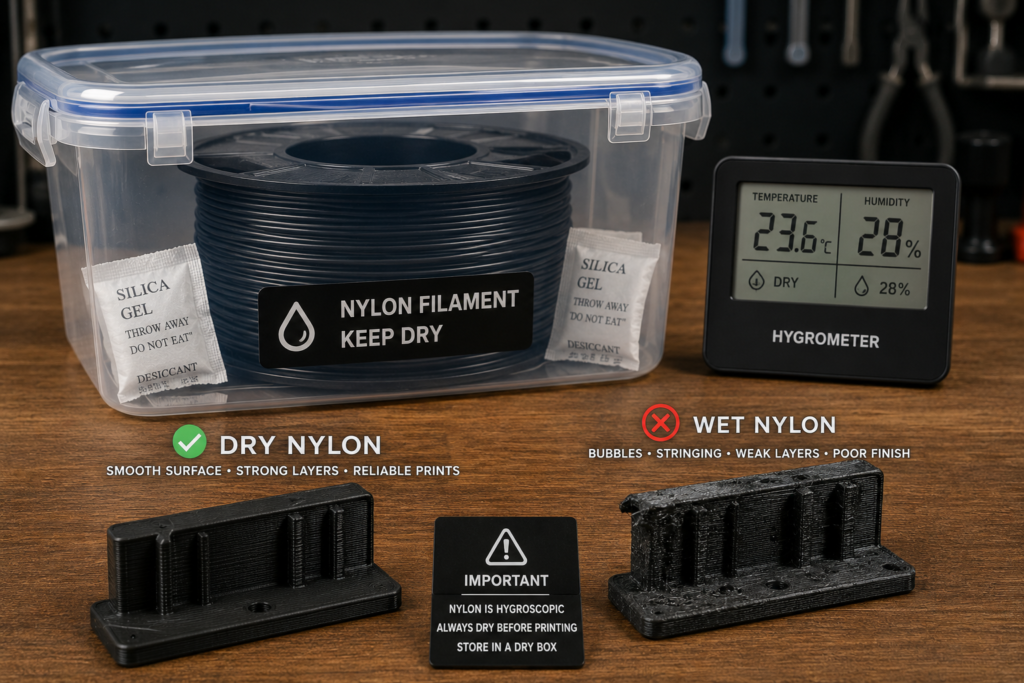
One of the biggest challenges with nylon is moisture absorption.
Nylon is hygroscopic.
This means it absorbs water from the surrounding air.
Even filament that appears perfectly normal may contain enough moisture to cause printing problems.
Wet nylon can produce:
When the wet filament enters the hot end, absorbed moisture can turn into steam.
That steam interferes with the extrusion process.
For high-quality engineering prints, proper filament drying is not an optional detail.
It is part of the manufacturing process.
The correct drying temperature and time depend on the exact filament.
Different manufacturers use different polyamide formulations.
For this reason, the filament manufacturer’s drying instructions should always take priority over a generic internet setting.
Professional handling may involve:
In some environments, nylon can begin absorbing meaningful amounts of moisture surprisingly quickly.
Leaving a spool exposed for days and expecting identical print quality is not a particularly effective engineering strategy.
Nylon can shrink as it cools.
This creates internal stress in the print.
If those forces become strong enough, the part may:
Large nylon parts can therefore be much more difficult to print than small components.
Successful printing may require:
The exact requirements depend heavily on the nylon grade.
Some modern nylon blends are specifically formulated to reduce warping.
An enclosure can significantly improve consistency when printing some nylon materials.
It helps reduce rapid temperature changes and drafts around the part.
This can reduce internal stress and warping.
However, not every nylon filament requires identical chamber conditions.
Some modified nylon grades have been developed for easier printing and may tolerate less controlled environments.
The manufacturer’s recommended printing conditions should therefore be followed.
FDM prints are anisotropic.
This means their mechanical properties are not identical in every direction.
A part is often stronger along the deposited extrusion paths than across the boundaries between layers.
Nylon can provide strong layer bonding when printed correctly, but orientation still matters.
For load-bearing parts, consider:
Sometimes simply rotating the model before printing can dramatically improve the finished part.
A high-performance material cannot compensate for inadequate geometry.
Wall thickness can have a major effect on strength.
For functional parts, increasing perimeter count or reinforcing critical sections may produce greater benefits than simply increasing infill.
Important design areas include:
Fillets can also help reduce stress concentrations.
A properly designed nylon part can be extremely durable.
A badly designed nylon part is still a badly designed part, merely made from more expensive filament.
Increasing infill can improve mechanical performance, but it should not be treated as the only strength control.
Part strength also depends on:
For many functional components, increasing the number of walls can be more useful than simply pushing infill towards 100%.
A future guide on (How Infill Affects 3D Printing Strength) will examine this in more detail.
Nylon can be more difficult to print dimensionally accurately than materials such as PLA.
Potential issues include:
For mechanical assemblies, tolerances therefore need to be considered carefully.
A hole modelled at exactly the nominal shaft diameter may not necessarily produce the correct fit after printing.
Test pieces or prototypes may be useful for:
For production components, process repeatability matters just as much as nominal CAD dimensions.
Nylon can be used in some outdoor applications, but it should not automatically be considered the ideal outdoor material.
Moisture absorption can affect dimensional and mechanical behaviour.
Long-term UV exposure can also affect some nylon formulations.
For parts intended to remain outdoors permanently, materials such as ASA or suitable engineering polymers may sometimes be more appropriate.
The environment should be evaluated for:
Our future (Best Materials for Outdoor 3D Prints) guide will compare these requirements more closely.
Nylon provides useful resistance to many oils, fuels and chemicals, which can make it suitable for workshop and engineering environments.
However, chemical resistance depends on the exact nylon type, concentration, exposure time and temperature.
A component that experiences occasional contact with a chemical may behave very differently from a part permanently immersed in it.
For critical applications, the technical data for the exact material should always be checked.
Nylon is particularly attractive when a component requires several of the following properties:
Good examples include:
Nylon is not automatically the best material simply because it is considered an engineering filament.
It may be unnecessary for:
PLA or PETG may be easier, cheaper and entirely sufficient.
Nylon may also be unsuitable where the application requires:
In these cases, another engineering polymer or reinforced material may be more appropriate.
Material selection should solve an actual engineering requirement rather than simply use the most impressive filament name available.
Nylon can be particularly valuable for prototypes where the goal is to test real mechanical behaviour rather than simply check shape and dimensions.
A nylon prototype can help evaluate:
This can provide useful information before moving to injection moulding, machining or another production process.
3D printing can also make nylon practical for small production quantities.
There is no need for injection moulding tooling, which can make additive manufacturing attractive for:
Design changes can also be introduced without manufacturing a new mould.
For specialised components, this flexibility can be more important than achieving the lowest possible unit price at very high volumes.
Before choosing a nylon filament, consider the actual application.
Ask:
A tough unfilled nylon may be suitable.
A carbon-fibre or glass-fibre reinforced nylon may be more appropriate.
Fatigue resistance and wear behaviour become important.
Check the technical data for the exact nylon grade.
Consider shrinkage, moisture absorption and reinforcement.
Different nylon grades absorb different amounts of water.
Reinforced nylons can provide useful stiffness-to-weight performance.
A tough, less brittle grade may be preferable to maximum stiffness.
There is no universal “best nylon”.
The right material depends on the mechanical requirements of the part.
Nylon becomes particularly useful when the component has real functional requirements.
Professional material selection can be worthwhile when a part is:
At 3DRevolution, we can review your model and help determine whether nylon, PETG, ABS, carbon-fibre reinforced material or another option is appropriate for the application.
You can upload your STL or STEP file using our instant quote / upload page or learn more about our 3D printing service UK.
Nylon is one of the most useful engineering materials available for FDM 3D printing.
Its main advantage is not simply maximum tensile strength.
It is the combination of toughness, impact resistance, fatigue resistance, flexibility and wear performance that makes nylon valuable for functional mechanical components.
For gears, hinges, clips, bushings, moving parts and components exposed to repeated loading, nylon can offer significant advantages over common materials such as PLA.
However, nylon also requires more careful handling.
Moisture control, filament drying, print orientation, temperature management and part design all influence the final result.
Carbon-fibre and glass-fibre reinforced nylon can provide additional stiffness and dimensional stability, while unfilled nylon may be more suitable where flexibility and toughness are required.
The best nylon is therefore not simply the strongest one.
It is the grade whose mechanical, thermal and environmental properties match the real operating conditions of the finished part.