

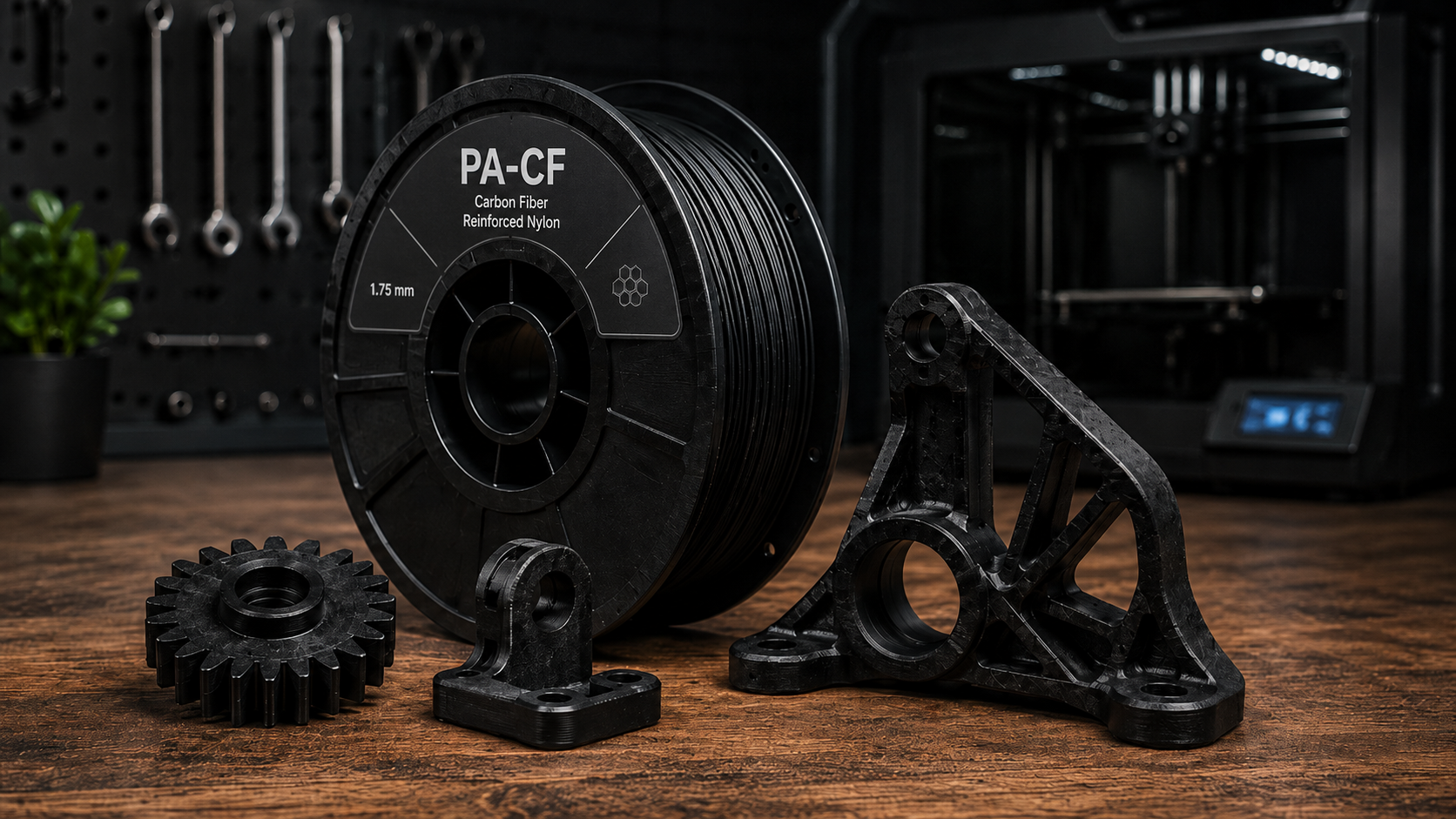
Carbon-fibre reinforced filament has become one of the most popular engineering materials for functional FDM 3D printing.
It is commonly used for brackets, jigs, fixtures, robotics components, drone parts, machine components and other applications where stiffness, dimensional stability and low deformation are important.
However, the term “carbon fibre filament” can be misleading.
Most carbon-fibre filaments used in conventional FDM printers are not made from continuous strands of carbon fibre like traditional aerospace or motorsport composite structures. Instead, they contain short chopped carbon fibres mixed into a thermoplastic base material such as nylon, PETG, polycarbonate, ABS or ASA.
These fibres can significantly change how the base polymer behaves.
They can increase stiffness, improve dimensional stability and reduce deformation, but they can also reduce flexibility and make some materials more brittle.
This means carbon-fibre reinforcement does not automatically make every material better or stronger in every situation.
In this guide, we explain how carbon-fibre reinforced filament works, how strong it really is, the differences between common CF materials, when it makes sense to use them and what limitations should be considered before choosing them for a functional part.
If you are comparing engineering materials generally, you may also want to read our Strongest Materials for 3D Printing guide.
For applications where toughness, wear resistance and repeated movement are particularly important, see Nylon 3D Printing – Strength and Durability.
If you already have a functional component ready for production, you can use our (3D printing service UK) or upload your STL or STEP file through our (instant quote / upload page).
Carbon-fibre reinforced filament is a composite 3D printing material.
A conventional thermoplastic acts as the base polymer, while small chopped carbon fibres are distributed throughout it.
Common base polymers include:
The resulting materials are often identified using abbreviations such as:
The letters before “CF” are important.
Carbon fibre modifies the material, but the base polymer still determines many of its fundamental properties.
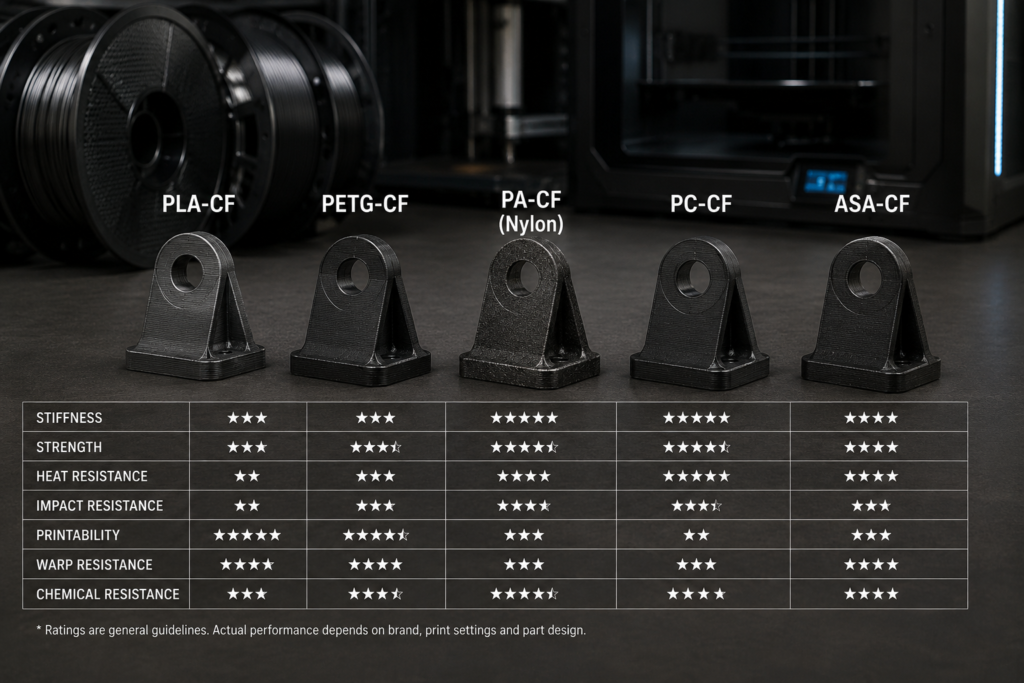
For example, PA-CF and PETG-CF may both contain carbon fibres, but they can behave very differently when exposed to heat, impact, moisture or repeated mechanical loading.
There is therefore no single material called simply “carbon fibre filament”.
Adding short carbon fibres can significantly alter the behaviour of a thermoplastic.
Depending on the formulation, carbon-fibre reinforcement can provide:
The fibres help resist deformation inside the polymer.
This is especially useful for components that need to maintain their geometry under mechanical load.
Typical examples include:
However, reinforcement also changes how the material fails.
A more rigid material is not necessarily a tougher material.
Carbon-fibre reinforced filament can produce very strong functional parts, but asking whether it is “stronger” than another material does not have one simple answer.
Strength can refer to several different properties:
Carbon-fibre reinforcement is particularly effective at increasing stiffness.
This means a part bends less when a load is applied.
For structural brackets, fixtures and precision components, that can be extremely valuable.
But stiffness and toughness are different.
A very stiff carbon-filled material can sometimes fail more suddenly under impact than an unfilled polymer that is able to flex.
For this reason, carbon-fibre filament should not automatically be treated as the strongest choice for every mechanical component.
A stiff material resists bending.
A strong material can carry significant load before failing.
A tough material can absorb energy and deformation before breaking.
Carbon-fibre reinforced materials are generally selected because of their stiffness and dimensional stability.
For example, an ordinary nylon bracket may flex considerably under load.
A similar bracket printed from carbon-fibre reinforced nylon may remain much more rigid.
That additional stiffness can improve:
However, the unfilled nylon version may sometimes tolerate greater bending or impact without cracking.
The correct choice depends on what the component actually needs to survive.
Our Strongest Materials for 3D Printing guide discusses strength, toughness and stiffness in more detail.
Carbon-fibre reinforced nylon is one of the most useful CF materials for engineering applications.
It combines the mechanical performance of nylon with significantly increased stiffness.
Depending on the exact grade, PA-CF can provide:
Typical uses include:
Carbon-fibre nylon can be particularly useful when ordinary nylon is mechanically suitable but too flexible.
However, reinforcement does not remove nylon’s sensitivity to moisture.
PA-CF filament normally still needs careful drying and storage.
Our Nylon 3D Printing – Strength and Durability guide explains nylon moisture absorption, drying and mechanical behaviour in greater detail.
PETG reinforced with carbon fibre offers a different balance of properties.
Standard PETG is already known for good layer adhesion, toughness and relatively easy printing.
Adding carbon fibre generally makes PETG:
PETG-CF can be useful for:
It can also be easier to print than some nylon-based engineering materials.
However, PETG-CF does not automatically provide the same mechanical or heat performance as PA-CF or PC-CF.
For applications requiring repeated flexing or high wear resistance, nylon may still be the better material.
Polycarbonate reinforced with carbon fibre is aimed at more demanding engineering applications.
Polycarbonate itself can provide excellent mechanical properties and useful temperature resistance.
Carbon-fibre reinforcement can significantly increase its stiffness and dimensional stability.
PC-CF can be suitable for:
However, PC-CF is also considerably more demanding to print.
Depending on the grade, it may require:
It should therefore be treated as a specialist engineering material rather than simply a premium replacement for PETG.
A future (Heat Resistant 3D Printing Materials) guide will compare materials suitable for higher-temperature environments in more detail.
ASA is widely used where outdoor durability and UV resistance are important.
Carbon-fibre reinforcement can increase stiffness and dimensional stability while retaining many of ASA’s useful environmental properties.
ASA-CF can therefore be attractive for:
The exact performance depends on the formulation.
If long-term outdoor use is a major requirement, UV resistance and temperature behaviour should always be checked using the manufacturer’s technical data.
A future (Best Materials for Outdoor 3D Prints) guide will examine outdoor material selection more closely.
PLA reinforced with carbon fibre is relatively easy to print and can produce very rigid parts with an attractive matte finish.
However, it is important not to confuse rigidity with overall engineering performance.
PLA-CF can be useful for:
However, the PLA base still has limited heat resistance and relatively low impact tolerance compared with tougher engineering polymers.
For heavily loaded or warm environments, another carbon-fibre base material may be more appropriate.
Standard nylon and carbon-fibre nylon can behave very differently.
For a snap-fit clip or flexible hinge, ordinary nylon may be the better choice.
For a rigid machine bracket, carbon-fibre nylon may be far more suitable.
Neither material is universally superior.
The application determines which property matters most.
Standard PETG is a practical material for many functional components.
It provides:
Carbon-fibre reinforced materials are generally considered when additional stiffness or dimensional stability is required.
PETG-CF itself can provide a useful middle ground between standard PETG and more demanding engineering materials.
For general functional parts, standard PETG may already be sufficient.
There is little benefit in selecting a more expensive abrasive filament if the design does not require the additional rigidity.
You may also want to read PLA vs PETG vs ABS – Which Material Is Best for a broader comparison of common FDM materials.
One common misunderstanding is that adding carbon fibre automatically improves impact resistance.
It may not.
Short fibres generally reduce the ability of the base polymer to stretch before failure.
This means a carbon-fibre reinforced material can become:
but sometimes also:
For impact-loaded parts, toughness may be more important than maximum stiffness.
A component designed to survive vibration, collisions or repeated movement may therefore perform better in standard nylon or another tough polymer.
Repeated mechanical loading can eventually damage any material.
This is known as fatigue.
Carbon-fibre reinforcement can reduce deformation, but fatigue performance still depends heavily on the base polymer.
A nylon-based carbon-fibre filament may behave very differently from a PLA-based carbon-fibre filament.
For components exposed to repeated movement, consider:
Simply selecting a carbon-fibre material does not remove the need for good engineering design.
Carbon fibres can reduce thermal contraction and dimensional movement in some base polymers.
This can make reinforced materials easier to print dimensionally accurately.
For example, some PA-CF formulations warp less than unfilled nylon.
Potential benefits include:
However, this does not mean carbon-fibre filament cannot warp.
The base polymer still matters.
Materials such as PA-CF and PC-CF can still require controlled printing environments, good bed adhesion and appropriate temperature management.
FDM parts are anisotropic.
This means their strength depends partly on direction.
Carbon fibres tend to align with the extrusion path as the filament is deposited.
This can provide strong reinforcement along the printed roads.
However, the fibres do not create continuous reinforcement through the Z-axis between printed layers.
Layer bonding still depends on the base polymer and printing conditions.
Important factors include:
A carbon-fibre material can therefore produce a very stiff component that is still vulnerable if the main load pulls directly across weak layer boundaries.
Correct orientation remains extremely important.
Material selection cannot compensate for poor orientation.
Before printing a structural component, consider:
A correctly oriented PETG component can sometimes outperform a badly oriented carbon-fibre component.
This is slightly inconvenient for anyone hoping expensive filament could replace engineering.
You may also want to read How to Check If a Model Is 3D Printable before manufacturing a functional part.
Wall thickness often has a greater effect on functional strength than simply increasing infill.
For mechanically loaded parts, important design considerations include:
Carbon-fibre filament works best when the geometry itself is designed to carry load efficiently.
Very thin sections can still fail even when printed from expensive engineering materials.
Higher infill can increase strength, but it should not be treated as the only structural control.
Part performance also depends on:
For many brackets and structural components, adding more walls can provide a more efficient increase in strength than simply increasing infill towards 100%.
A future guide on (How Infill Affects 3D Printing Strength) will examine this topic in greater detail.
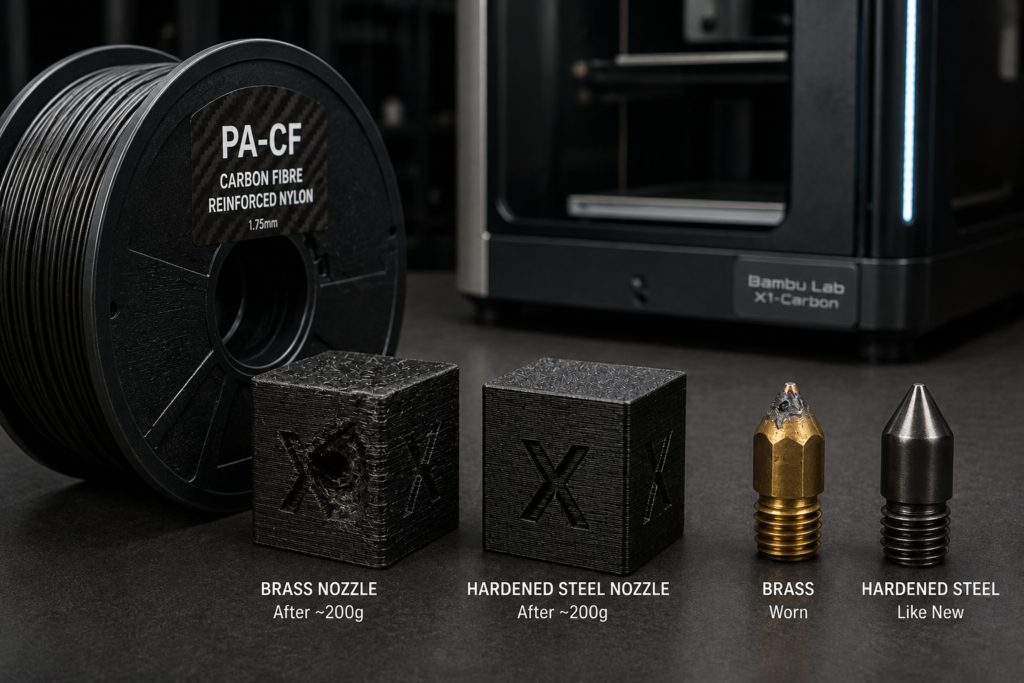
One of the most important practical differences between standard and carbon-fibre filament is abrasion.
Carbon fibres are abrasive.
As filament repeatedly passes through the nozzle, those fibres can wear soft nozzle materials.
A standard brass nozzle can therefore wear significantly faster when printing carbon-fibre reinforced filament.
Nozzle wear can gradually increase the nozzle diameter and affect:
For regular carbon-fibre printing, an abrasion-resistant nozzle is normally recommended.
Common options include:
The exact recommendation depends on the printer and filament manufacturer.
Some carbon-fibre filaments can be printed using a 0.4 mm nozzle.
However, the chopped fibres increase the risk of partial clogging compared with conventional filament.
For this reason, some manufacturers recommend larger nozzle diameters such as 0.6 mm for reinforced materials.
A larger nozzle can provide:
But nozzle choice also affects detail and print time.
The filament manufacturer’s recommendations should therefore be checked before production.
Moisture can significantly affect many engineering polymers.
This is particularly important with nylon-based carbon-fibre filament.
Wet material may produce:
Filament drying and dry storage should therefore be considered part of the manufacturing process.
Depending on the polymer, printing directly from a dry box may also be beneficial.
Our Nylon 3D Printing – Strength and Durability guide covers moisture control for nylon-based materials in more detail.
That depends primarily on the base polymer.
PLA-CF or some PETG-CF materials may print successfully without a heated enclosure.
PA-CF, ABS-CF, ASA-CF and PC-CF may benefit significantly from controlled temperatures.
An enclosure can help reduce:
For demanding engineering materials, stable printing conditions can be just as important as the filament itself.
Carbon-fibre reinforced filament often produces a distinctive matte surface finish.
Layer lines can appear less visually prominent than with glossy materials.
This technical appearance is popular for:
However, surface appearance should not be confused with structural performance.
A professional-looking matte component can still fail if it is poorly oriented or incorrectly printed.
One of the major advantages of carbon-fibre reinforcement can be improved dimensional stability.
Reduced shrinkage and flexing can help produce more predictable geometry.
This can be valuable for:
However, tolerances still need to account for the additive manufacturing process.
Factors affecting final dimensions include:
For precision assemblies, prototype fitting may still be required.
Carbon-fibre reinforced filament is particularly useful when a component needs to remain rigid under load.
Typical applications include:
It is especially valuable where ordinary thermoplastics deform too much.
Robotics components often require a combination of stiffness, low weight and dimensional accuracy.
Carbon-fibre reinforced materials can work well for:
Reduced flexing can improve mechanical precision.
For moving joints or impact-loaded parts, however, a tougher unfilled polymer may sometimes be more appropriate.
Weight and stiffness are particularly important in drone components.
Carbon-fibre reinforced filament can be useful for:
However, chopped-fibre FDM filament should not be confused with continuous carbon-fibre composite plates or tubes.
Traditional continuous-fibre composites can provide much higher structural performance.
A future (3D Printing for Carbon Fiber Parts) guide will explore these applications in greater detail.
Jigs and fixtures are excellent applications for carbon-fibre reinforced materials.
These components often need:
Examples include:
Because tooling may only be required in small quantities, 3D printing can also avoid the cost and lead time of machining complex fixtures.
Carbon-fibre reinforced material may be appropriate when a part requires:
It is particularly useful when ordinary nylon, PETG or another polymer is mechanically adequate but too flexible.
Carbon-fibre filament is not automatically the best option simply because the application is mechanical.
Another material may be more suitable where the part requires:
Standard nylon can be preferable for flexible mechanical components.
PETG can be entirely sufficient for many general-purpose brackets.
PLA may still be appropriate for rigid indoor components where heat and impact are not concerns.
Choosing the most expensive material without a mechanical reason rarely improves the design.
Before selecting a CF material, consider the actual operating conditions.
PA-CF, PC-CF or another engineering-grade reinforced polymer may be suitable.
Do not judge the material only by stiffness. Toughness may be more important.
Consider fatigue performance and whether an unfilled nylon would perform better.
Check the technical data for the exact base polymer.
Consider UV resistance and environmental exposure.
A reinforced material can offer improved stability, but print calibration and design tolerances still matter.
A carbon-fibre material may not be the best choice.
The correct material is determined by the job, not by the presence of carbon fibre in the product name.
Material selection becomes particularly important when a component is:
At 3DRevolution, we can review your model and help determine whether carbon-fibre reinforced nylon, PETG-CF, standard nylon, PETG or another material is appropriate for your application.
You can upload your STL or STEP file through our instant quote / upload page or learn more about our 3D printing service UK.
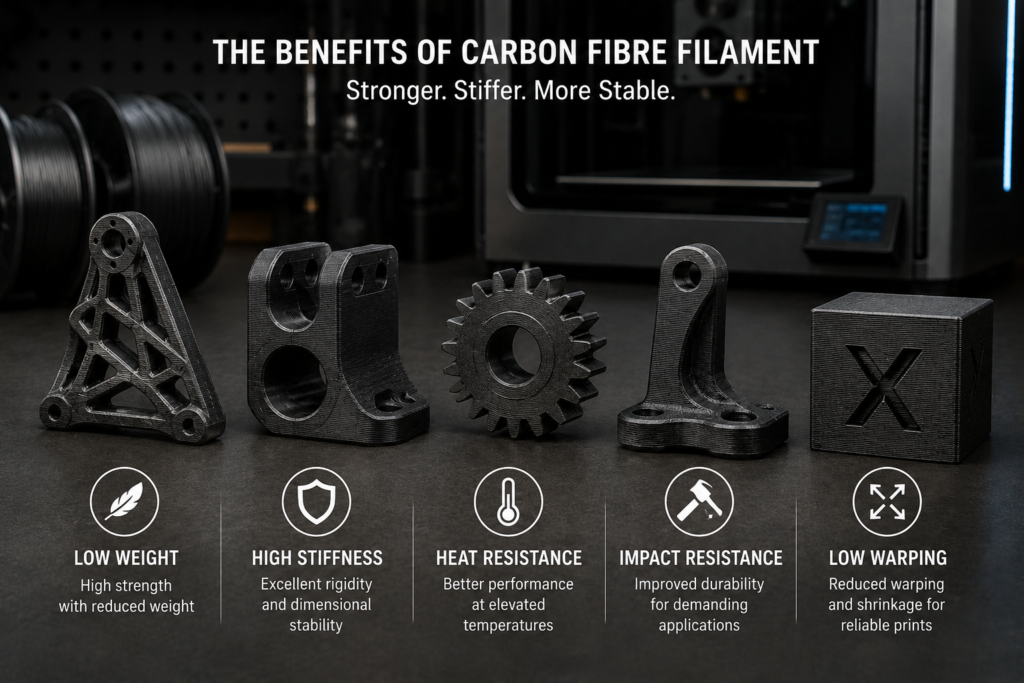
Carbon-fibre reinforced filament can provide excellent performance for functional FDM 3D printing.
Its main advantages are increased stiffness, reduced deformation and improved dimensional stability.
These properties make reinforced materials useful for brackets, fixtures, robotics components, drone parts, tooling and other engineering applications.
However, carbon fibre does not automatically make a polymer stronger in every way.
Reinforcement can reduce flexibility and impact tolerance, while the underlying polymer continues to determine properties such as heat resistance, moisture sensitivity and fatigue behaviour.
PA-CF, PETG-CF, PC-CF, ASA-CF and PLA-CF therefore serve different purposes.
Successful carbon-fibre 3D printing also requires suitable hardware. Abrasion-resistant nozzles, correct printing conditions, proper filament drying and sensible part orientation all influence the finished result.
The best carbon-fibre filament is not simply the one with the highest fibre content or the most impressive specification.
It is the material whose combination of stiffness, toughness, temperature resistance and environmental performance matches the real requirements of the finished part.