

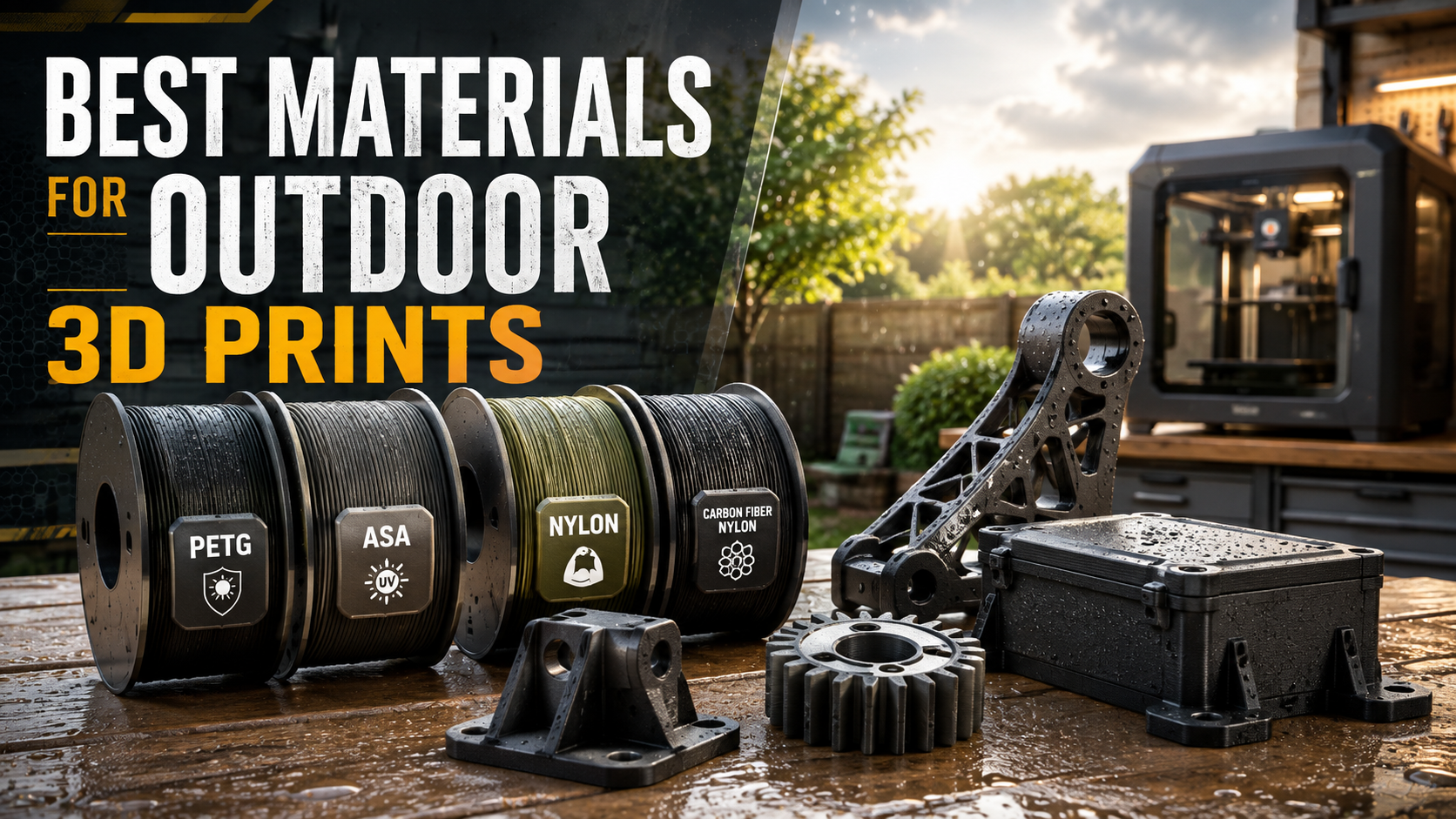
Choosing a material for an outdoor 3D printed part is more complicated than simply asking which filament is strongest.
Outdoor components may need to survive sunlight, UV radiation, rain, humidity, temperature changes, heat, frost and repeated mechanical loading.
A material that performs perfectly indoors can gradually become brittle, fade, deform or lose strength when exposed to the weather.
This is particularly important for functional parts such as:
PETG, ASA, ABS, nylon and engineering-grade reinforced materials can all be used outdoors, but they offer very different combinations of weather resistance, heat resistance, toughness and dimensional stability.
In this guide, we compare some of the best materials for outdoor 3D printing and explain when PETG, ASA, ABS, nylon, polycarbonate and carbon-fibre reinforced filaments make sense.
If you are comparing materials more generally, you may also want to read our Strongest Materials for 3D Printing guide.
For applications where temperature is particularly important, see our (Heat Resistant 3D Printing Materials) guide.
If you already have a part ready for production, you can use our 3D printing service UK or upload your STL or STEP file through our instant quote / upload page.
Outdoor durability depends on several properties working together.
Important factors include:
No single property determines whether a material will survive outdoors.
For example, a filament may be highly water resistant but still suffer from long-term UV degradation.
Another material may handle sunlight well but soften when exposed to high temperatures.
The best outdoor material therefore depends on the actual environment.
Sunlight contains ultraviolet radiation.
Over time, UV exposure can damage some polymers.
Possible effects include:
The process is usually gradual.
A part may look perfectly normal after several weeks outdoors but change considerably after months or years of exposure.
This is why long-term outdoor parts require more than simple water resistance.
ASA is particularly useful because it was developed with improved UV and weather resistance.
Rain itself does not automatically damage every filament.
Materials such as PETG and ASA provide good resistance to moisture.
However, some polymers absorb water from the surrounding environment.
Nylon is a good example.
Nylon can absorb moisture from the air and surrounding environment, which can affect:
This does not mean nylon cannot be used outdoors.
It simply means the application must tolerate the material’s moisture behaviour.
Our Nylon 3D Printing – Strength and Durability guide explains moisture absorption in nylon in more detail.
Outdoor parts experience changing temperatures throughout the day and throughout the year.
A component may be exposed to:
Dark-coloured parts exposed to direct sunlight can become significantly hotter than the surrounding air.
This is particularly important for components mounted on:
A material that is technically suitable at normal ambient temperature may still soften when heated directly by the sun.
For common FDM materials, a practical outdoor comparison looks like this.
Best for:
Main advantages:
Main limitation:
Best for:
Main advantages:
Main limitation:
Best for:
Main advantages:
Main limitation:
Best for:
Main advantages:
Main limitation:
Best for:
Main advantages:
Main limitation:
Best for:
Main advantages:
Main limitation:
Our Carbon Fibre Reinforced Filament Guide explains why the polymer before the letters “CF” matters so much.
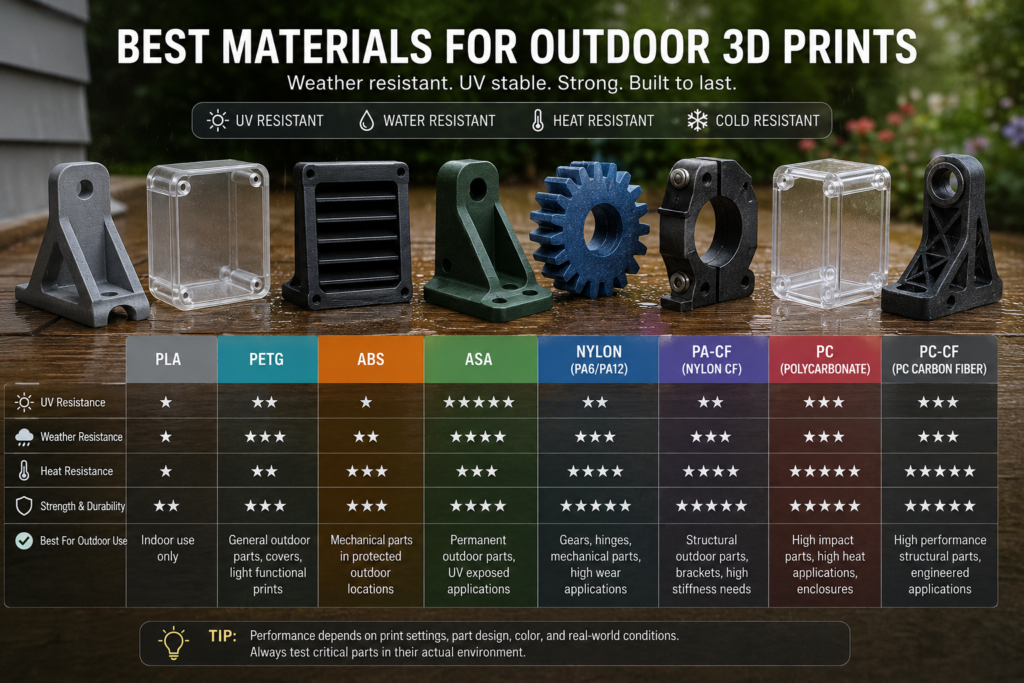
PETG is one of the most practical materials for general outdoor use.
It combines:
PETG is commonly used for:
For many non-critical outdoor components, PETG provides an excellent balance between durability and manufacturing difficulty.
It is much easier to print reliably than many engineering materials.
PETG generally performs reasonably well outdoors, but long-term UV durability can vary between formulations.
Colourants, additives and exact polymer chemistry all influence ageing.
For permanent installations exposed to strong sunlight for many years, ASA is generally a more purpose-designed choice.
For moderate outdoor use, however, PETG can be entirely sufficient.
This is why material selection should consider the required service life.
A garden bracket expected to last several seasons has different requirements from a permanent outdoor sensor housing expected to remain installed for ten years.
PETG offers better heat resistance than standard PLA.
However, dark PETG parts exposed to direct summer sunlight can still become warm enough for temperature to affect stiffness.
This becomes particularly important if the part is carrying a continuous load.
Examples include:
If higher heat resistance is required, ASA, ABS, nylon, polycarbonate or suitable reinforced materials may be more appropriate.
ASA is one of the strongest general recommendations for permanent outdoor 3D printed parts.
It provides many of the useful mechanical characteristics associated with ABS while offering significantly improved resistance to UV radiation and weather exposure.
ASA can provide:
This combination makes it particularly suitable for outdoor applications.
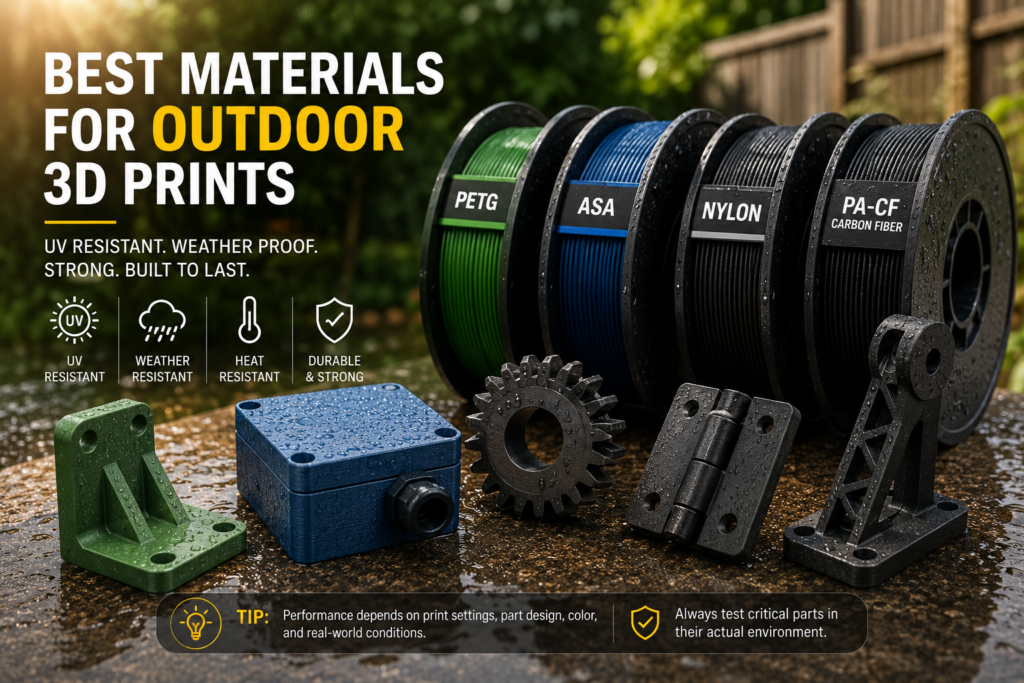
ASA is often used for:
It is especially useful where the component needs to maintain both appearance and mechanical performance under long-term sunlight.
PETG and ASA are both strong candidates for outdoor printing.
For a simple outdoor bracket or garden component, PETG may be perfectly suitable.
For a permanent UV-exposed enclosure or automotive exterior component, ASA may be the better choice.
The required lifespan matters.
ASA is more demanding to print than PETG.
Like ABS, it tends to shrink while cooling.
This can cause:
Successful ASA printing often benefits from:
A good material printed badly is still capable of producing a bad part. Polymers remain stubbornly unwilling to compensate for poor process control.
ABS can be used outdoors, but it has an important limitation.
Standard ABS does not offer the same UV resistance as ASA.
Long-term sunlight exposure can gradually reduce its mechanical properties and affect its appearance.
ABS still provides useful:
For outdoor components protected from direct sunlight, ABS may perform very well.
However, where permanent UV exposure is expected, ASA is usually the more appropriate option.
A future guide on (When to Use ABS for 3D Printing) will examine ABS applications in greater detail.
Nylon offers excellent mechanical properties.
It can provide:
This makes nylon attractive for outdoor mechanical components such as:
However, nylon absorbs moisture.
Water absorption can change its mechanical and dimensional behaviour.
For some applications this is acceptable.
For precision components, dimensional assemblies or permanently exposed parts, it may be a significant limitation.
UV resistance varies between nylon formulations.
Standard nylon should not automatically be assumed to offer excellent long-term UV stability.
Some engineering nylons contain stabilisers specifically designed for outdoor environments.
If a nylon part will remain outdoors permanently, the manufacturer’s technical data should therefore be checked.
The word “nylon” alone is not enough to determine outdoor performance.
Carbon-fibre reinforced nylon can provide excellent stiffness and mechanical stability.
This makes it attractive for:
However, reinforcement does not eliminate the properties of the nylon base.
PA-CF can still:
Carbon fibre increases stiffness.
It does not magically waterproof the periodic table.
For outdoor PA-CF components, the exact polymer formulation remains important.
Polycarbonate can provide excellent mechanical and thermal performance.
Properties can include:
This makes PC attractive for demanding outdoor components.
However, standard polycarbonate can be affected by long-term UV exposure.
Commercial outdoor polycarbonate products often contain UV stabilisers or protective coatings.
The same consideration applies to filament.
If PC will be used permanently outdoors, check whether the specific filament is designed for UV exposure.
Carbon-fibre reinforced polycarbonate combines the thermal performance of polycarbonate with greater stiffness and dimensional stability.
PC-CF can be useful for:
However, it is a demanding material to print and long-term UV performance again depends on the exact formulation.
It should generally be chosen because the application actually requires its mechanical and thermal performance.
PLA can technically be placed outdoors.
That does not make it a good general outdoor material.
Its main limitations include:
PLA components may survive outdoors for surprisingly long periods in sheltered conditions.
However, performance is unpredictable compared with materials specifically suited to environmental exposure.
PLA is therefore better reserved for:
For serious long-term functional components, another material is generally preferable.
A common mistake is to design around weather forecast temperature.
If the forecast says 30°C, the actual surface temperature of a dark plastic component exposed to sunlight can be considerably higher.
The part absorbs solar radiation.
This is particularly important for black or dark-coloured components.
Potential consequences include:
This is why outdoor material selection often overlaps with heat-resistant material selection.
Our (Heat Resistant 3D Printing Materials) guide examines this issue in greater detail.
Colour influences how much solar energy a component absorbs.
Dark colours typically absorb more solar radiation than lighter colours.
This means two otherwise identical components can experience different surface temperatures outdoors.
For thermally sensitive materials, this may influence performance.
Material colour should therefore be considered alongside:
For critical applications, real operating temperature should ideally be measured rather than guessed.
Outdoor humidity can matter even when a component is protected from direct rain.
Hygroscopic polymers can absorb moisture from humid air.
Nylon is particularly sensitive to this.
Moisture can influence:
This means a component may behave differently during a dry summer and a wet winter.
For precision assemblies, this variation can matter.
Outdoor parts in colder climates may experience repeated freezing and thawing.
These cycles can place additional stress on components.
Water trapped in:
can expand when it freezes.
Good outdoor part design should therefore avoid unnecessary areas where water can collect.
Drainage can sometimes be just as important as material choice.
Material selection is only one part of outdoor durability.
The model itself should be designed for the environment.
Consider:
A well-designed PETG component may survive longer than a badly designed ASA component.
The alphabet printed on the filament spool does not exempt the designer from physics.
Outdoor components can experience:
Wall thickness should therefore match the expected loading.
Functional components may benefit from:
Very thin walls can fail regardless of the material used.
FDM components are anisotropic.
They are usually strongest along the deposited extrusion paths and weaker across layer boundaries.
Outdoor loads may come from unpredictable directions.
Examples include:
Part orientation should therefore be chosen according to the expected load direction.
Our How to Check If a Model Is 3D Printable guide can help identify potential manufacturing issues before production.
Higher infill does not automatically create a dramatically stronger outdoor component.
Part performance also depends on:
For many functional parts, additional walls provide a more useful strength increase than simply increasing infill.
A future (How Infill Affects 3D Printing Strength) guide will explore this topic in more detail.
Outdoor electronics create several challenges at once.
The enclosure may need resistance to:
PETG can work well for many general-purpose enclosures.
ASA can be particularly suitable for permanent weather-exposed housings.
More demanding thermal applications may require engineering polymers.
The enclosure design should also consider:
A suitable polymer cannot compensate for a hole that allows rain directly onto the circuit board.
Automotive components can experience extremely demanding conditions.
Possible requirements include:
ASA can be particularly useful for exterior automotive components.
PA-CF or PC-CF may be appropriate for more demanding structural applications.
Material choice depends on the exact location and function of the part.
A future (3D Printing for Automotive Parts) guide will examine automotive applications separately.
Not every outdoor component requires an engineering polymer.
PETG can be ideal for many ordinary applications such as:
ASA may be worth the additional printing difficulty when the component will remain exposed to sunlight permanently.
Material should be selected according to the real requirement, not according to which filament has the longest technical name.
Moving outdoor parts have additional requirements.
A hinge or gear may need:
Nylon can be excellent mechanically but moisture and UV exposure must be considered.
ASA provides strong environmental resistance but may not match nylon’s fatigue performance.
There is rarely one perfect material.
The best solution depends on which property matters most.
Outdoor parts may also encounter chemicals.
Examples include:
Chemical compatibility varies significantly between polymers.
For components exposed to chemicals, the technical data for the exact filament should be checked.
General material names alone are not enough for safety-critical applications.
PETG is often the best starting point when:
It offers an excellent balance for general-purpose outdoor parts.
ASA becomes particularly attractive when:
For many permanent outdoor components, ASA is one of the strongest overall choices.
Nylon may be the best option when:
However, moisture and UV exposure must be considered carefully.
Carbon-fibre reinforced materials can be valuable when:
The base polymer still determines environmental performance.
ASA-CF, PA-CF and PC-CF therefore behave very differently outdoors.
Our Carbon Fibre Reinforced Filament Guide explains these differences in more detail.
Before selecting a material, ask:
Consider ASA or a specifically UV-stabilised engineering polymer.
PETG and ASA provide useful moisture resistance.
Consider temperature, creep and stiffness as well as basic strength.
Nylon may provide better fatigue resistance.
Consider ASA, nylon, polycarbonate or an appropriate reinforced material.
Moisture absorption and thermal expansion become important.
A carbon-fibre reinforced polymer may be suitable.
PETG may provide the best practical compromise.
The best outdoor material is the one whose environmental and mechanical properties match the actual conditions.
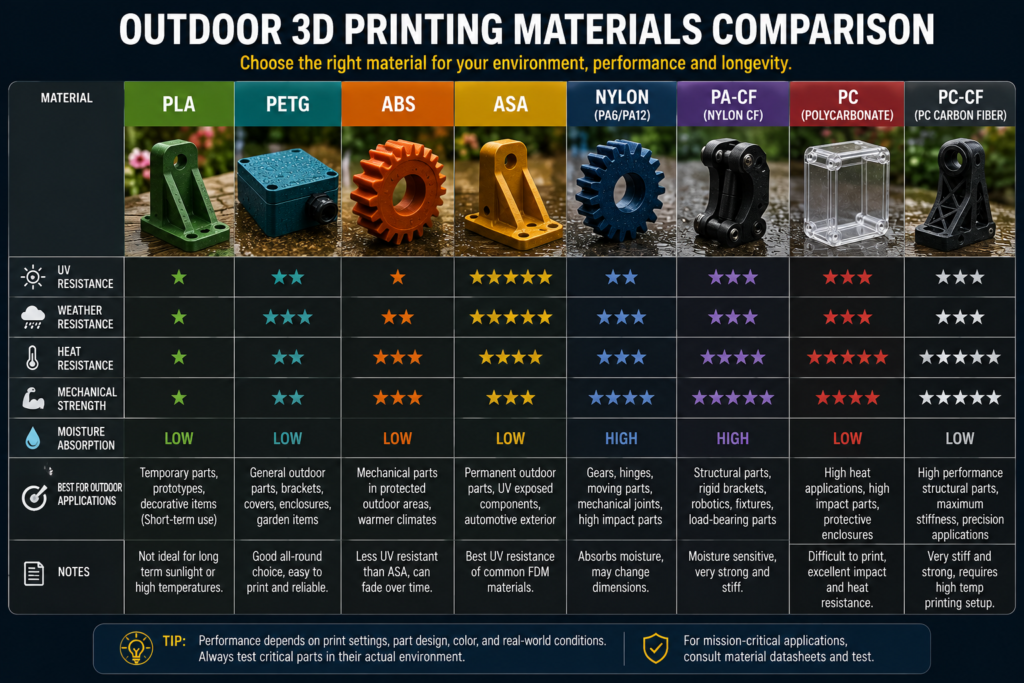
Engineering polymers are impressive.
They are also unnecessary for many simple outdoor components.
A PETG bracket may perform perfectly for years.
Replacing it with PC-CF purely because PC-CF sounds more advanced does not automatically improve the design.
Higher-performance materials may introduce:
Material selection should therefore be proportional to the application.
Material selection becomes particularly important when an outdoor component is:
At 3DRevolution, we can review your model and help determine whether PETG, ASA, nylon, carbon-fibre reinforced material, polycarbonate or another polymer is appropriate for the application.
You can upload your STL or STEP file through our instant quote / upload page or learn more about our 3D printing service UK.
There is no single best material for every outdoor 3D printed part.
PETG offers an excellent balance of toughness, moisture resistance and printability for general outdoor applications.
ASA is one of the strongest choices for permanent outdoor parts because of its excellent UV and weather resistance.
ABS provides useful mechanical and heat performance but is less suitable for long-term direct sunlight than ASA.
Nylon offers outstanding toughness, fatigue resistance and wear performance but requires careful consideration of moisture and UV exposure.
Polycarbonate and reinforced engineering materials can provide additional heat resistance, stiffness and structural performance for more demanding applications.
The correct material depends on:
A reliable outdoor 3D printed part therefore comes from combining the right material with suitable geometry, correct print orientation and a realistic understanding of the environment in which the component will spend its life.